
September 11, 2026
Ready to increase your revenue?
Join thousands of ecommerce brands using PostPilot to acquire more customers & keep them coming back again (and again).
No contracts. No minimums.


You’ve probably heard the same ecommerce lead generation advice a million times: Build a lead magnet, run a Meta campaign, capture an email, send a welcome flow. Rinse and repeat.
If you’ve actually tried any of the advice in the real world with your brand, you’ve probably also noticed that you often end up with expensive leads that don’t convert.
It’s not that these tactics don’t work. They do! Well… they did. The channel got crowded, and the math got worse. Meta CPMs rose 20% YoY, with a median CPA of $38.17 and a median ROAS of 1.93 across nearly 35,000 ecommerce brands. It’s a good playbook, but when everyone is using it to run the same plays, it becomes harder to stand out.
So where do brands go from here?
One option is a channel with a 4.4% average response rate that your prospects interact with almost every day: direct mail.
Direct mail lead generation isn’t just a nostalgia play to remind customers of the better times. It’s a strategic targeting play that lets you build an audience from your owned customer data, reach that audience in their mailbox, measure the results, and improve performance over time.
In this article, we’ll show you how to actually generate quality leads using direct mail so you can liven up that playbook and your ROAS.
For the uninitiated, direct mail lead generation is pretty much exactly what it sounds like: it’s when you use physical mail—postcards, Cardalogs™, catalogs—to reach people who aren’t customers yet and turn them into first-time buyers.
While we’ve highlighted the benefits of direct mail as a powerful retargeting tool in the past, it’s just as effective when it comes to lead generation. The strategies overlap, but the primary difference is the goal: anything that ends in a first-time purchase is considered lead generation. Cold prospects, anonymous site visitors, and non-buying subscribers all count.
To measure success, don’t just focus on response rate. Sure, it can show you whether people are engaging with your campaign, but incremental ROAS (iROAS) is the metric that will tell you whether your campaign is actually generating revenue that you wouldn’t have earned otherwise.
You might be wondering why one of the oldest marketing tactics in human history has re-emerged as a viable lead generation alternative.
The proof is in the benchmarks:
The truth is, in 2026, everyone’s inbox is filled to the brim. But their mailboxes? Not so much. Direct mail gives brands a way to stand out from the digital noise with a memorable, tangible marketing experience.
So how exactly do you build a direct mail lead generation program? We compiled 6 strategies—many of which include real customer examples—to help you transition from digital devotee to a direct mail pro with ease.
We touched on it earlier: direct mail is old. As old as the printing press, oil paintings, and even delicious whiskey. So it’s no surprise that most direct mail targeting is still built on old concepts: you buy a batch of names from a data broker, filter by zip code and income bracket, mail out your materials, and hope for the best.
It’s the real-world, mailbox equivalent of a broad interest audience on Meta. It’s also why direct mail has become synonymous with junk mail.
But it doesn’t have to be that way! Modern prospecting tactics exist, and they can help you build an audience from the most reliable data you can get: your own.
It’s as easy as feeding your first-party purchase data into a lookalike model and letting it handle the rest. It will find households that behave like your highest-LTV (lifetime value) customers. All you have to do is feed the model data points like:
The powers of digital and physical combine, giving you lookalike audience data you can use to reliably build a direct mail lead generation campaign with confidence, not with guesswork.
While it’s not rocket science, it feels pretty close: AcquisitionAI (PostPilot’s proprietary lookalike engine) builds these audiences from billions of demographic and behavioral data points in hours, not weeks. It can run one-off or fully automated prospecting campaigns on a set budget and cadence. And all you have to do is put the customer data you’ve already been collecting to work.
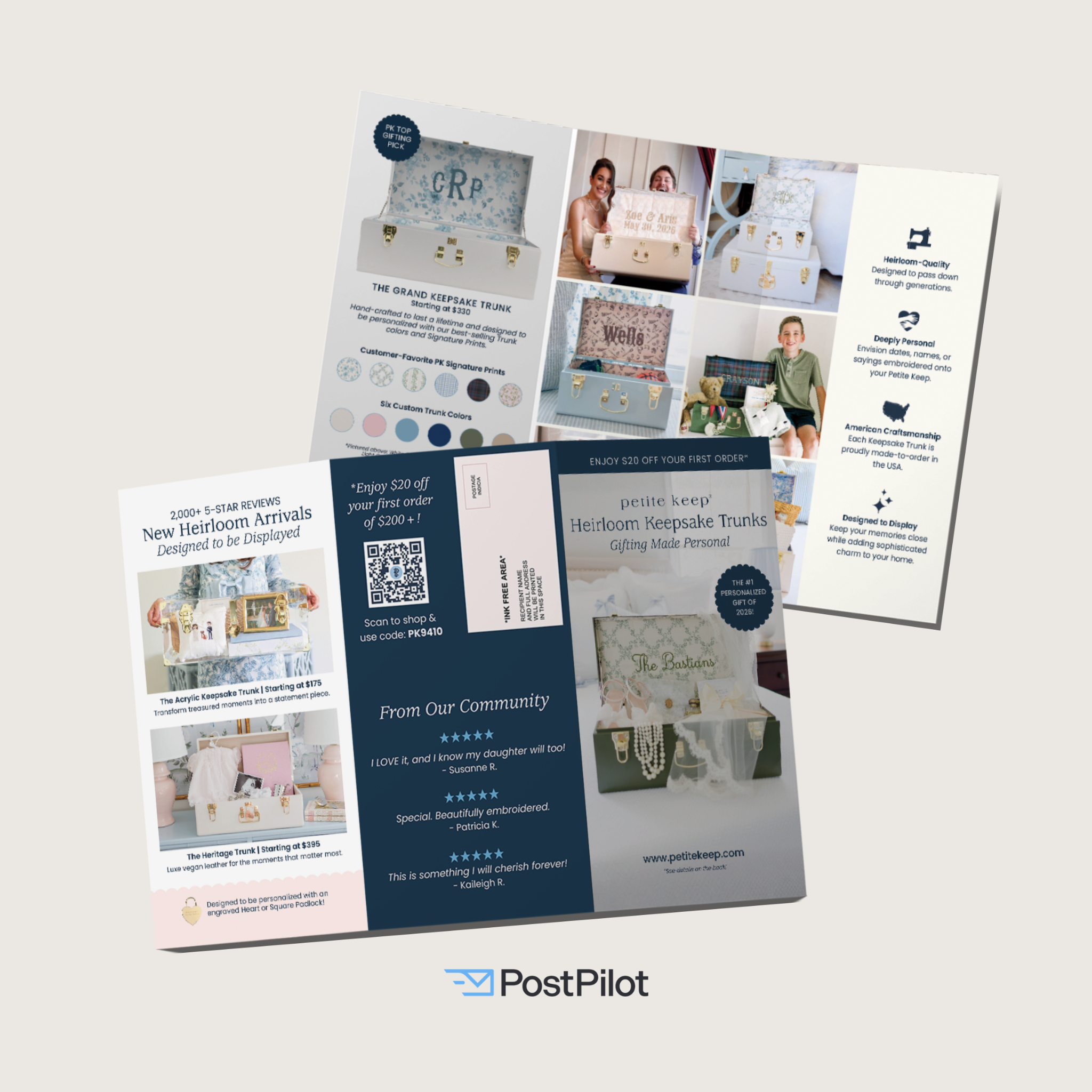
Heirloom trunk brand Petite Keep creates keepsakes made to be cherished for generations, and working with PostPilot, they developed a cold prospecting program that’s as sturdy as their trunks.
Using AcquisitionAI, they extended their already-effective retargeting and retention program into cold prospecting, mailing trifold Cardalogs™ to tens of thousands of prospects with a gifting angle.
The results were more than worth writing home about. We might even go as far as saying they’re worthy of being stored in one of those beautiful trunks: their February campaign drove a 6.36x iROAS, and their May campaign drove a 5.41x iROAS.
While math is rarely fun, especially when the numbers are uncomfortable, we have to face the statistical reality: the average Shopify store converts around 1.4% of sessions. Aside from returning customers and word-of-mouth referrals, you're paying for the majority of that traffic.
To make matters worse, most of these visitors are anonymous: no email addresses, no accounts, no pixels that survive iOS. They’re digital ghosts.
But with SiteMatch™, those ghosts can be busted. SiteMatch identifies anonymous site visitors, uses AI to score their likelihood to buy, and only mails the ones worth mailing. This means your budget follows intent instead of paying to cast an extremely wide net.
Plus, SiteMatch allows you to:

Barker Beds, the vet-recommended dog bed brand, got cozy with SiteMatch, using it to convert anonymous browsers into first-time buyers with a paws-itively solid 2.95x ROAS.
This campaign gave Barker Beds a second chance to reintroduce their brand to shoppers who needed a little more time to decide. By leading with evidence-based messaging like “Backed by science,” they earned trust with prospects who had already shown intent, nudging them over the finish line and bringing in new customers.
Every brand has them. And by “them,” we mean subscribers who signed up, never bought anything, and now sit in a “cold” segment getting monthly newsletters they don’t open.
This doesn’t mean they’re hopeless. It just means they’re unreachable in that channel. Deliverability failures, full inboxes, and promo-tab exile all look identical to disinterest from inside Klaviyo.
But MailMatch™ can give that list of checked-out prospects a chance to check back in. It matches email addresses to physical addresses, allowing you to put offers in the hands of the people your email flows were never actually reaching.
These are some segments worth mailing:

Cookware brand HexClad said “yes, chef!” to using postcards for direct mail lead generation, taking advantage of Black Friday/Cyber Monday to reach out to 21,000 people who had signed up for their email list but never converted.
And while we’re not ones to reuse our jokes, that audience definitely said “yes, chef!” right back, driving $800,000 in sales from new customers. Delicious!
Direct mail marketing isn’t like socks or sunglasses: one size does not fit all.
Not every lead needs the same piece of paper. Format is a targeting decision, not a design one. Some common pairings of format and targeting include:
When planning your direct mail marketing campaign, don’t just decide to do a postcard campaign or a catalog campaign. Consider your audience first, and choose the format that makes the most sense.
Newborn essentials brand Caden Lane had tried it all: Google, Facebook, TV, podcasts, affiliates, and more. Some of it worked, some of it didn’t. So, working with PostPilot, they decided to think outside the box and try direct mail as a lead generation tool.
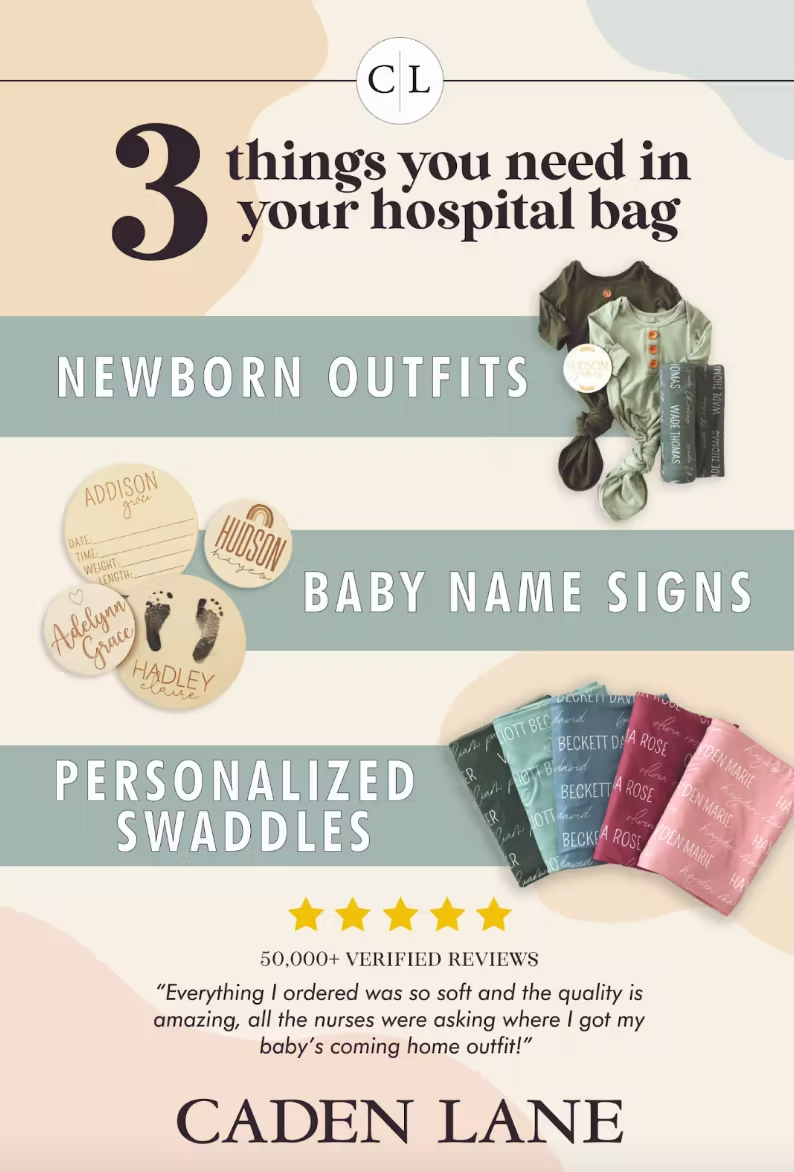
They built a list of 60,000 expecting moms and mailed them a postcard of what they’d need when their baby arrived. These were mothers-to-be with zero previous touchpoints or interactions with the brand.
Their goal was simply to break even and win some new customers, but the campaign more than delivered (pun intended) with a 3.8x ROAS. It turns out that many expecting parents already want to buy. They just need something tangible to remind them of what they need and who to buy it from.
Caden Lane’s success is a great indicator that postcards can work as a prospecting tool with a carefully considered audience, and that direct mail can be the opening touch, not just the follow-up.
We’re often asked about the most common lead gen mistake brands make, and it’s an easy answer: recycling retention creative for a cold audience.
Saying “we miss you” to someone who has never interacted with your brand is like saying “you too!” to the movie theater employee who told you to “enjoy the show.” It’s awkward, embarrassing, and doesn’t make any sense.
While the movie theater employee will quickly move on from your transgression, customers might not be as forgiving: 71% of customers say irrelevant brand messages make them feel frustrated.
Instead, your cold-audience mailer has to be extremely purposeful and laser-focused. In about three seconds, it should say:
To help you get started, we’ve built a handy creative checklist for cold direct mail outreach:
A common misconception is that personalization doesn’t apply to cold audiences, but there’s definitely room to include it: geography, category affinity, and household signals are all fair game.
Looking for creative inspiration? Check out our Design Studio for high-ROI direct mail examples from real brands, including prospecting campaigns.
When it comes to proving campaign success, it all comes down to the data. Before you scale your exciting new direct mail campaign, make sure it’s working as intended.
Here’s how: withhold a randomized slice of your target audience, then mail the rest. Afterward, compare purchase rates. The delta is what direct mail actually created. From there, layer in matchback reporting to tie orders back to mailed households, plus promo codes for a directional read.
This is especially important in lead gen. Retention audiences likely would have purchased at some point anyway. Cold audiences, on the other hand, give you a much cleaner incrementality test.
If you need to source a strong cold audience, look no further than PostPilot’s AcquisitionAI. AcquisitionAI drove 124% stronger results than the leading consumer data provider in a head-to-head comparison for a 9-figure women's apparel brand.
Once you’re confident in your audience, it’s time to scale using this 4-step process:
Once you find what works, you’re no longer guessing. You’re building a repeatable lead generation playbook you can keep scaling.
We’ll say it again: the traditional lead generation playbook isn’t dead, it’s just overused.
But by combining the strategies discussed in this article, you can:
The old playbook still has value, but it needs some new plays. If you’re ready to transform customers’ mailboxes from Amazon package drop points into an effective lead generation channel, we can help.
Ask us how PostPilot works, and let’s build a campaign that increases your iROAS and sets you apart from the competition.
You’ve probably heard the same ecommerce lead generation advice a million times: Build a lead magnet, run a Meta campaign, capture an email, send a welcome flow. Rinse and repeat.
If you’ve actually tried any of the advice in the real world with your brand, you’ve probably also noticed that you often end up with expensive leads that don’t convert.
It’s not that these tactics don’t work. They do! Well… they did. The channel got crowded, and the math got worse. Meta CPMs rose 20% YoY, with a median CPA of $38.17 and a median ROAS of 1.93 across nearly 35,000 ecommerce brands. It’s a good playbook, but when everyone is using it to run the same plays, it becomes harder to stand out.
So where do brands go from here?
One option is a channel with a 4.4% average response rate that your prospects interact with almost every day: direct mail.
Direct mail lead generation isn’t just a nostalgia play to remind customers of the better times. It’s a strategic targeting play that lets you build an audience from your owned customer data, reach that audience in their mailbox, measure the results, and improve performance over time.
In this article, we’ll show you how to actually generate quality leads using direct mail so you can liven up that playbook and your ROAS.
For the uninitiated, direct mail lead generation is pretty much exactly what it sounds like: it’s when you use physical mail—postcards, Cardalogs™, catalogs—to reach people who aren’t customers yet and turn them into first-time buyers.
While we’ve highlighted the benefits of direct mail as a powerful retargeting tool in the past, it’s just as effective when it comes to lead generation. The strategies overlap, but the primary difference is the goal: anything that ends in a first-time purchase is considered lead generation. Cold prospects, anonymous site visitors, and non-buying subscribers all count.
To measure success, don’t just focus on response rate. Sure, it can show you whether people are engaging with your campaign, but incremental ROAS (iROAS) is the metric that will tell you whether your campaign is actually generating revenue that you wouldn’t have earned otherwise.
You might be wondering why one of the oldest marketing tactics in human history has re-emerged as a viable lead generation alternative.
The proof is in the benchmarks:
The truth is, in 2026, everyone’s inbox is filled to the brim. But their mailboxes? Not so much. Direct mail gives brands a way to stand out from the digital noise with a memorable, tangible marketing experience.
So how exactly do you build a direct mail lead generation program? We compiled 6 strategies—many of which include real customer examples—to help you transition from digital devotee to a direct mail pro with ease.
We touched on it earlier: direct mail is old. As old as the printing press, oil paintings, and even delicious whiskey. So it’s no surprise that most direct mail targeting is still built on old concepts: you buy a batch of names from a data broker, filter by zip code and income bracket, mail out your materials, and hope for the best.
It’s the real-world, mailbox equivalent of a broad interest audience on Meta. It’s also why direct mail has become synonymous with junk mail.
But it doesn’t have to be that way! Modern prospecting tactics exist, and they can help you build an audience from the most reliable data you can get: your own.
It’s as easy as feeding your first-party purchase data into a lookalike model and letting it handle the rest. It will find households that behave like your highest-LTV (lifetime value) customers. All you have to do is feed the model data points like:
The powers of digital and physical combine, giving you lookalike audience data you can use to reliably build a direct mail lead generation campaign with confidence, not with guesswork.
While it’s not rocket science, it feels pretty close: AcquisitionAI (PostPilot’s proprietary lookalike engine) builds these audiences from billions of demographic and behavioral data points in hours, not weeks. It can run one-off or fully automated prospecting campaigns on a set budget and cadence. And all you have to do is put the customer data you’ve already been collecting to work.
Heirloom trunk brand Petite Keep creates keepsakes made to be cherished for generations, and working with PostPilot, they developed a cold prospecting program that’s as sturdy as their trunks.
Using AcquisitionAI, they extended their already-effective retargeting and retention program into cold prospecting, mailing trifold Cardalogs™ to tens of thousands of prospects with a gifting angle.
The results were more than worth writing home about. We might even go as far as saying they’re worthy of being stored in one of those beautiful trunks: their February campaign drove a 6.36x iROAS, and their May campaign drove a 5.41x iROAS.
While math is rarely fun, especially when the numbers are uncomfortable, we have to face the statistical reality: the average Shopify store converts around 1.4% of sessions. Aside from returning customers and word-of-mouth referrals, you're paying for the majority of that traffic.
To make matters worse, most of these visitors are anonymous: no email addresses, no accounts, no pixels that survive iOS. They’re digital ghosts.
But with SiteMatch™, those ghosts can be busted. SiteMatch identifies anonymous site visitors, uses AI to score their likelihood to buy, and only mails the ones worth mailing. This means your budget follows intent instead of paying to cast an extremely wide net.
Plus, SiteMatch allows you to:
Barker Beds, the vet-recommended dog bed brand, got cozy with SiteMatch, using it to convert anonymous browsers into first-time buyers with a paws-itively solid 2.95x ROAS.
This campaign gave Barker Beds a second chance to reintroduce their brand to shoppers who needed a little more time to decide. By leading with evidence-based messaging like “Backed by science,” they earned trust with prospects who had already shown intent, nudging them over the finish line and bringing in new customers.
Every brand has them. And by “them,” we mean subscribers who signed up, never bought anything, and now sit in a “cold” segment getting monthly newsletters they don’t open.
This doesn’t mean they’re hopeless. It just means they’re unreachable in that channel. Deliverability failures, full inboxes, and promo-tab exile all look identical to disinterest from inside Klaviyo.
But MailMatch™ can give that list of checked-out prospects a chance to check back in. It matches email addresses to physical addresses, allowing you to put offers in the hands of the people your email flows were never actually reaching.
These are some segments worth mailing:
Cookware brand HexClad said “yes, chef!” to using postcards for direct mail lead generation, taking advantage of Black Friday/Cyber Monday to reach out to 21,000 people who had signed up for their email list but never converted.
And while we’re not ones to reuse our jokes, that audience definitely said “yes, chef!” right back, driving $800,000 in sales from new customers. Delicious!
Direct mail marketing isn’t like socks or sunglasses: one size does not fit all.
Not every lead needs the same piece of paper. Format is a targeting decision, not a design one. Some common pairings of format and targeting include:
When planning your direct mail marketing campaign, don’t just decide to do a postcard campaign or a catalog campaign. Consider your audience first, and choose the format that makes the most sense.
Newborn essentials brand Caden Lane had tried it all: Google, Facebook, TV, podcasts, affiliates, and more. Some of it worked, some of it didn’t. So, working with PostPilot, they decided to think outside the box and try direct mail as a lead generation tool.
They built a list of 60,000 expecting moms and mailed them a postcard of what they’d need when their baby arrived. These were mothers-to-be with zero previous touchpoints or interactions with the brand.
Their goal was simply to break even and win some new customers, but the campaign more than delivered (pun intended) with a 3.8x ROAS. It turns out that many expecting parents already want to buy. They just need something tangible to remind them of what they need and who to buy it from.
Caden Lane’s success is a great indicator that postcards can work as a prospecting tool with a carefully considered audience, and that direct mail can be the opening touch, not just the follow-up.
We’re often asked about the most common lead gen mistake brands make, and it’s an easy answer: recycling retention creative for a cold audience.
Saying “we miss you” to someone who has never interacted with your brand is like saying “you too!” to the movie theater employee who told you to “enjoy the show.” It’s awkward, embarrassing, and doesn’t make any sense.
While the movie theater employee will quickly move on from your transgression, customers might not be as forgiving: 71% of customers say irrelevant brand messages make them feel frustrated.
Instead, your cold-audience mailer has to be extremely purposeful and laser-focused. In about three seconds, it should say:
To help you get started, we’ve built a handy creative checklist for cold direct mail outreach:
A common misconception is that personalization doesn’t apply to cold audiences, but there’s definitely room to include it: geography, category affinity, and household signals are all fair game.
Looking for creative inspiration? Check out our Design Studio for high-ROI direct mail examples from real brands, including prospecting campaigns.
When it comes to proving campaign success, it all comes down to the data. Before you scale your exciting new direct mail campaign, make sure it’s working as intended.
Here’s how: withhold a randomized slice of your target audience, then mail the rest. Afterward, compare purchase rates. The delta is what direct mail actually created. From there, layer in matchback reporting to tie orders back to mailed households, plus promo codes for a directional read.
This is especially important in lead gen. Retention audiences likely would have purchased at some point anyway. Cold audiences, on the other hand, give you a much cleaner incrementality test.
If you need to source a strong cold audience, look no further than PostPilot’s AcquisitionAI. AcquisitionAI drove 124% stronger results than the leading consumer data provider in a head-to-head comparison for a 9-figure women's apparel brand.
Once you’re confident in your audience, it’s time to scale using this 4-step process:
Once you find what works, you’re no longer guessing. You’re building a repeatable lead generation playbook you can keep scaling.
We’ll say it again: the traditional lead generation playbook isn’t dead, it’s just overused.
But by combining the strategies discussed in this article, you can:
The old playbook still has value, but it needs some new plays. If you’re ready to transform customers’ mailboxes from Amazon package drop points into an effective lead generation channel, we can help.
Ask us how PostPilot works, and let’s build a campaign that increases your iROAS and sets you apart from the competition.

Join thousands of ecommerce brands using PostPilot to acquire more customers & keep them coming back again (and again).
No contracts. No minimums.