
October 16, 2026
Ready to increase your revenue?
Join thousands of ecommerce brands using PostPilot to acquire more customers & keep them coming back again (and again).
No contracts. No minimums.


50% of subscribers churn before their second order. If you run a DTC subscription business, you've probably already felt it.
I've audited dozens of subscription brands doing 8 to 9 figures, and the immediate reaction to that unavoidable drop-off point is adding another flow, or rewriting the subject line and increasing the send frequency.
The problem with these tactics is that roughly half of your subscribers never meaningfully engage with email at all. That's a channel problem, and it's a common one.
So stop chasing subscribers with flows when they don’t bother opening their emails.
I want to be precise about what I'm arguing here, because it's not "email doesn't work."
Email is still the highest-ROI channel most subscription brands have, and if yours isn't running the basics well, that's the first fix, not the one I’m explaining here.
But email has a structural limit that no amount of segmentation or design work gets you past: it only reaches subscribers who open email.
Direct mail, specifically automated direct mail, doesn't have any such limits.
It’s triggered by the same parameters you use in Klaviyo, but it lands in a physical mailbox that gets checked regardless of inbox behaviour.
In short, it's the channel that reaches the subscribers your flows were never going to reach in the first place.
So, it acts as the coverage for the gap email leaves open. Here's where that gap actually shows up across your subscriber lifecycle, and what to put in it.
As Drew Sanocki, Founder & Co-CEO of PostPilot says:
“After buying 3 x 8+-figure brands, I learned that, on average, 50–80% of your customer list is functionally dead to your email marketing. Yet these are people who already know and trust your brand enough to have purchased before.
So, take whatever is working in email and "echo" it through direct mail.
The other 80%? Completely unreachable through our highest-ROI digital channel. They unsubscribed. Or weren’t opening. So we added direct mail to all our digital retention strategies to reactivate hundreds of thousands of previously "dead" emails.”
Order 1 to order 2 is where most of that 50% churn happens.
The standard response is a longer welcome email sequence: product education, usage tips, a completion challenge to build the habit before the second charge lands.
But that sequence works only for subscribers who open it.
However, a first-box mailer reinforces the same commitment physically, at the exact point where churn risk is highest, and it reaches the subscriber whether or not they've engaged with a single welcome email.
This way, you’re covering your highest-risk window with more than one channel.
Making a reward visible to a subscriber, a gift at order two, a perk at order three, is one of the more effective churn-reduction tactics in email. It also depends entirely on the subscriber opening the email that tells them about it.
Portland Leather Goods runs an automated birthday-triggered postcard.
One flow generates hundreds of thousands of dollars a month at 15x+ ROAS.
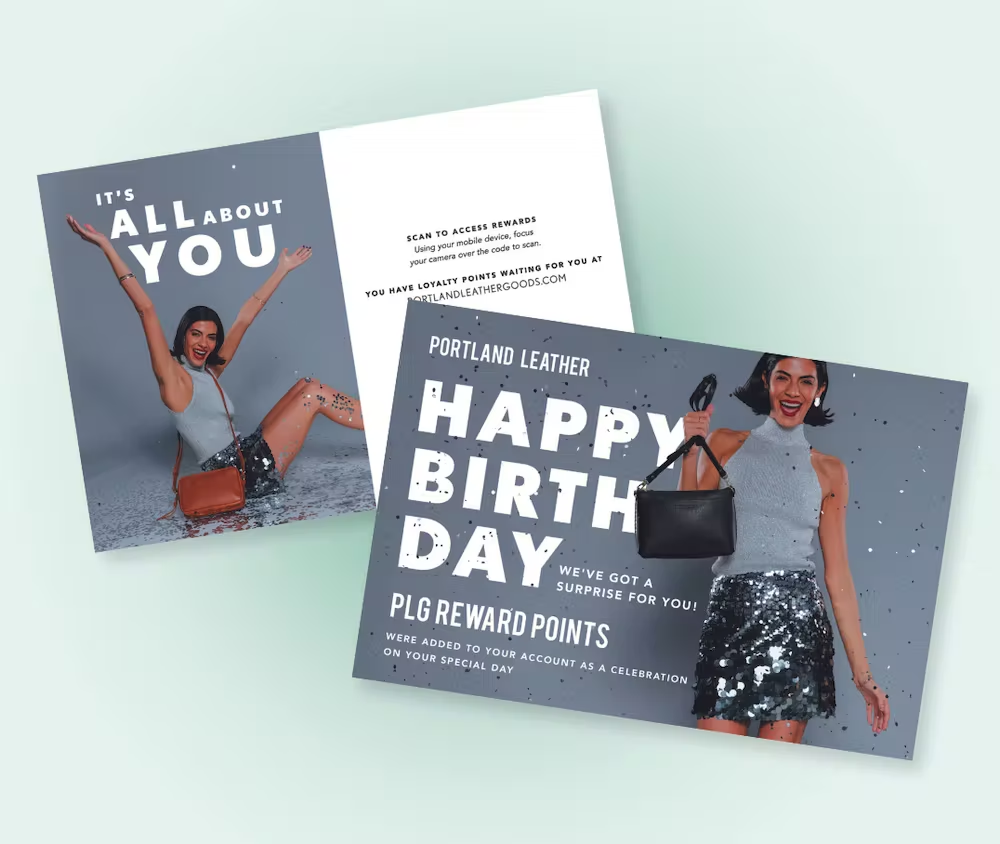
That's the same mechanic as an order-milestone mailer: a reward, triggered automatically, that arrives whether the subscriber has been opening your emails or not.
Taylor Stitch runs automated postcards targeting customers with two or more purchases who've gone quiet for 90-plus days. Kindred Bravely does the same thing seasonally, with "we miss you" messaging that keeps running well past the initial send.
Both are aimed at exactly the segment a DTC subscription business is most at risk of losing quietly: subscribers who've paused, gone dormant, or stopped opening anything you send.

Winback direct mail is the physical equivalent of tapping someone on the shoulder instead of leaving another email they'll never read. They work precisely because they don’t depend on the subscriber checking an inbox they've already tuned out.
I've made this argument before about winback email specifically: segment by historical order frequency and LTV, and don't waste a winback touch on a subscriber who was never going to be worth recovering. The same discipline applies here, it just travels through a different channel.
One collagen brand in a Zaymo-run holdout test generated more than £700,000 in annual upgrade revenue from emails sent before the first and second renewal.
That's a big number, sitting on a moment most brands leave completely silent. If your own cohort data shows anything close to it, the pre-renewal window deserves more than a single email and a bit of hope.
Think of a pre-renewal mailer as insurance. Emails get missed, buried, ignored, it happens even in a good sequence, and that's exactly the moment PostPilot's replenishment-reminder mechanic is built to catch.
If a £700k upside exists in the inbox, it's worth protecting with a channel that doesn't depend on the inbox at all.
If customers do happen to churn from your subscription program, it’s time to pull out all the stops to get them back.
Granted, email (and SMS) should remain your workhorses, but sending customers direct mail to bring them back as subscribers can translate into hundreds or thousands of dollars of LTV every year.
Laird Superfood does this by sending churned customers postcards by cancellation reason.

Whether it’s a general “no reason,” objection to price, or product section, they’re able to get back in front of ex-subscribers, and they’re guaranteed to have a touchpoint those ex-subscribers won’t miss.
They may not be opening emails, but there’s no way they’re going to miss a postcard(s).
None of this works as a blanket "mail everyone" play, and I'd be suspicious of anyone pitching it that way.
Pareto’s law states that roughly 50% of sales come from the top 20% of a brand’s buyers in most categories. That's where the reward and pre-renewal mailers earn their cost per touch, on the subscribers with the order frequency and LTV to justify it.
Winback works the other way round: it's built for the lapsed and dormant segment specifically, not for subscribers who are already engaging fine through email.
If you mail indiscriminately you'll end up spending a lot to say very little. But if you segment it properly, it becomes the highest-relevance channel in the stack, because a physical mailer addressed to a specific milestone or a specific absence actually gets noticed.
Now, if your subscription programme is currently one welcome flow and one cancellation flow, don't start with all five of these moments at once. Start with the win-back segment because it's the one sitting on the most immediate lost revenue. PostPilot's retention tools are built specifically to automate it off the back of your existing Shopify and Klaviyo data.
Then work backwards to the welcome window once winback is running cleanly.
Retention isn't one channel doing more work. It's making sure every high-risk moment in the subscriber lifecycle has a channel that can actually reach the subscriber standing in it.
For a lot of your subscribers, that channel still isn't email.
How does direct mail improve subscription retention?
Direct mail reaches subscribers regardless of email engagement, which matters because a large share of any subscriber list doesn't open email at all. Applied at the highest-risk lifecycle moments, welcome, milestone, win-back and pre-renewal, it covers the churn risk that email-only programmes miss by design, not by execution.
How do I reduce churn in my subscription service?
Start by tracking churn by order number rather than by calendar month, since that's where the real drop-off shows up. Then close the two biggest gaps: interactive options (delay, skip, swap) inside your billing and renewal emails for subscribers who open them, and a direct mail touch at the same moment for subscribers who don't.
How do you win back churned subscribers?
Segment lapsed and dormant subscribers by historical order frequency and lifetime value, then reach them through a channel that doesn't depend on email engagement they've already stopped giving you. Automated win-back postcards, triggered off 90-plus days of inactivity, are built for exactly this segment.
What's a good response rate for direct mail marketing?
Direct mail typically outperforms email response rates by a wide margin, roughly 9% versus 1% per Association of National Advertisers benchmarks. Actual results vary by segment, offer and how well-targeted the mailer is.
How does direct mail fit alongside email and SMS?
As coverage, not a replacement. Email and SMS should still carry your day-to-day flows and campaigns; direct mail's job is reaching the subscribers and moments those channels structurally can't, chiefly non-openers and high-stakes lifecycle points like renewal.
Is direct mail still effective for ecommerce brands?
Yes, and increasingly so as inboxes get more crowded. Programmatic platforms now trigger mail automatically off the same Shopify and Klaviyo data driving your email programme, so it runs with the same automation logic without needing a separate manual process.
50% of subscribers churn before their second order. If you run a DTC subscription business, you've probably already felt it.
I've audited dozens of subscription brands doing 8 to 9 figures, and the immediate reaction to that unavoidable drop-off point is adding another flow, or rewriting the subject line and increasing the send frequency.
The problem with these tactics is that roughly half of your subscribers never meaningfully engage with email at all. That's a channel problem, and it's a common one.
So stop chasing subscribers with flows when they don’t bother opening their emails.
I want to be precise about what I'm arguing here, because it's not "email doesn't work."
Email is still the highest-ROI channel most subscription brands have, and if yours isn't running the basics well, that's the first fix, not the one I’m explaining here.
But email has a structural limit that no amount of segmentation or design work gets you past: it only reaches subscribers who open email.
Direct mail, specifically automated direct mail, doesn't have any such limits.
It’s triggered by the same parameters you use in Klaviyo, but it lands in a physical mailbox that gets checked regardless of inbox behaviour.
In short, it's the channel that reaches the subscribers your flows were never going to reach in the first place.
So, it acts as the coverage for the gap email leaves open. Here's where that gap actually shows up across your subscriber lifecycle, and what to put in it.
As Drew Sanocki, Founder & Co-CEO of PostPilot says:
“After buying 3 x 8+-figure brands, I learned that, on average, 50–80% of your customer list is functionally dead to your email marketing. Yet these are people who already know and trust your brand enough to have purchased before.
So, take whatever is working in email and "echo" it through direct mail.
The other 80%? Completely unreachable through our highest-ROI digital channel. They unsubscribed. Or weren’t opening. So we added direct mail to all our digital retention strategies to reactivate hundreds of thousands of previously "dead" emails.”
Order 1 to order 2 is where most of that 50% churn happens.
The standard response is a longer welcome email sequence: product education, usage tips, a completion challenge to build the habit before the second charge lands.
But that sequence works only for subscribers who open it.
However, a first-box mailer reinforces the same commitment physically, at the exact point where churn risk is highest, and it reaches the subscriber whether or not they've engaged with a single welcome email.
This way, you’re covering your highest-risk window with more than one channel.
Making a reward visible to a subscriber, a gift at order two, a perk at order three, is one of the more effective churn-reduction tactics in email. It also depends entirely on the subscriber opening the email that tells them about it.
Portland Leather Goods runs an automated birthday-triggered postcard.
One flow generates hundreds of thousands of dollars a month at 15x+ ROAS.
That's the same mechanic as an order-milestone mailer: a reward, triggered automatically, that arrives whether the subscriber has been opening your emails or not.
Taylor Stitch runs automated postcards targeting customers with two or more purchases who've gone quiet for 90-plus days. Kindred Bravely does the same thing seasonally, with "we miss you" messaging that keeps running well past the initial send.
Both are aimed at exactly the segment a DTC subscription business is most at risk of losing quietly: subscribers who've paused, gone dormant, or stopped opening anything you send.
Winback direct mail is the physical equivalent of tapping someone on the shoulder instead of leaving another email they'll never read. They work precisely because they don’t depend on the subscriber checking an inbox they've already tuned out.
I've made this argument before about winback email specifically: segment by historical order frequency and LTV, and don't waste a winback touch on a subscriber who was never going to be worth recovering. The same discipline applies here, it just travels through a different channel.
One collagen brand in a Zaymo-run holdout test generated more than £700,000 in annual upgrade revenue from emails sent before the first and second renewal.
That's a big number, sitting on a moment most brands leave completely silent. If your own cohort data shows anything close to it, the pre-renewal window deserves more than a single email and a bit of hope.
Think of a pre-renewal mailer as insurance. Emails get missed, buried, ignored, it happens even in a good sequence, and that's exactly the moment PostPilot's replenishment-reminder mechanic is built to catch.
If a £700k upside exists in the inbox, it's worth protecting with a channel that doesn't depend on the inbox at all.
If customers do happen to churn from your subscription program, it’s time to pull out all the stops to get them back.
Granted, email (and SMS) should remain your workhorses, but sending customers direct mail to bring them back as subscribers can translate into hundreds or thousands of dollars of LTV every year.
Laird Superfood does this by sending churned customers postcards by cancellation reason.
Whether it’s a general “no reason,” objection to price, or product section, they’re able to get back in front of ex-subscribers, and they’re guaranteed to have a touchpoint those ex-subscribers won’t miss.
They may not be opening emails, but there’s no way they’re going to miss a postcard(s).
None of this works as a blanket "mail everyone" play, and I'd be suspicious of anyone pitching it that way.
Pareto’s law states that roughly 50% of sales come from the top 20% of a brand’s buyers in most categories. That's where the reward and pre-renewal mailers earn their cost per touch, on the subscribers with the order frequency and LTV to justify it.
Winback works the other way round: it's built for the lapsed and dormant segment specifically, not for subscribers who are already engaging fine through email.
If you mail indiscriminately you'll end up spending a lot to say very little. But if you segment it properly, it becomes the highest-relevance channel in the stack, because a physical mailer addressed to a specific milestone or a specific absence actually gets noticed.
Now, if your subscription programme is currently one welcome flow and one cancellation flow, don't start with all five of these moments at once. Start with the win-back segment because it's the one sitting on the most immediate lost revenue. PostPilot's retention tools are built specifically to automate it off the back of your existing Shopify and Klaviyo data.
Then work backwards to the welcome window once winback is running cleanly.
Retention isn't one channel doing more work. It's making sure every high-risk moment in the subscriber lifecycle has a channel that can actually reach the subscriber standing in it.
For a lot of your subscribers, that channel still isn't email.
How does direct mail improve subscription retention?
Direct mail reaches subscribers regardless of email engagement, which matters because a large share of any subscriber list doesn't open email at all. Applied at the highest-risk lifecycle moments, welcome, milestone, win-back and pre-renewal, it covers the churn risk that email-only programmes miss by design, not by execution.
How do I reduce churn in my subscription service?
Start by tracking churn by order number rather than by calendar month, since that's where the real drop-off shows up. Then close the two biggest gaps: interactive options (delay, skip, swap) inside your billing and renewal emails for subscribers who open them, and a direct mail touch at the same moment for subscribers who don't.
How do you win back churned subscribers?
Segment lapsed and dormant subscribers by historical order frequency and lifetime value, then reach them through a channel that doesn't depend on email engagement they've already stopped giving you. Automated win-back postcards, triggered off 90-plus days of inactivity, are built for exactly this segment.
What's a good response rate for direct mail marketing?
Direct mail typically outperforms email response rates by a wide margin, roughly 9% versus 1% per Association of National Advertisers benchmarks. Actual results vary by segment, offer and how well-targeted the mailer is.
How does direct mail fit alongside email and SMS?
As coverage, not a replacement. Email and SMS should still carry your day-to-day flows and campaigns; direct mail's job is reaching the subscribers and moments those channels structurally can't, chiefly non-openers and high-stakes lifecycle points like renewal.
Is direct mail still effective for ecommerce brands?
Yes, and increasingly so as inboxes get more crowded. Programmatic platforms now trigger mail automatically off the same Shopify and Klaviyo data driving your email programme, so it runs with the same automation logic without needing a separate manual process.

Join thousands of ecommerce brands using PostPilot to acquire more customers & keep them coming back again (and again).
No contracts. No minimums.