
October 27, 2026
Ready to increase your revenue?
Join thousands of ecommerce brands using PostPilot to acquire more customers & keep them coming back again (and again).
No contracts. No minimums.


You know the holiday gift guide. You've probably received about 20 of them already.
A grid of products. A headline about finding the perfect gift. Maybe a little ribbon graphic in the corner to make it feel festive.
And, of course, another email competing for attention in an inbox that's already overflowing with holiday promotions.
But what happens when you take that same gift guide out of the inbox and put it in someone's mailbox?
Suddenly, you're working with something your customers can hold, flip through, leave on their kitchen counter, or revisit when they're trying to figure out what to buy their impossible-to-shop-for brother.
That's the opportunity with a holiday gift guide mailer.
Instead of simply announcing a sale, a well-designed postcard can help customers discover products, compare gifting options, and find something worth purchasing. Add a QR code or memorable shopping URL to create a direct connection between physical inspiration and your online store.
The trick is knowing what deserves a spot on the postcard.
Here are six holiday direct mail ideas worth borrowing, with real examples from brands using PostPilot and practical ways to turn your own product catalog into something customers actually want to browse.
Let's start with the easiest place to find gift ideas: the products your customers already love.
Every ecommerce brand has a handful of products that consistently outperform the rest of its catalog. They're the bestsellers, the products customers reorder, and the ones that seem to show up in every other customer review.
Why not make them the stars of your holiday gift guide?
Instead of squeezing 20 products onto a postcard, choose three to five bestsellers that represent your brand particularly well.
Give each product a beautiful image, a short description, and a reason someone might want to give it as a gift.
How to design it: Use one large hero image on the front of the postcard, with three or four smaller product features on the back. Include product names, prices where appropriate, and a QR code linking to a matching collection on your website.
Pizza oven brand Gozney turned its holiday mailer into a compact product discovery experience.
Its six-panel Cardalog opened with the headline "Ignite the Season" and featured its Dome, Roccbox, and Dome S1 pizza ovens.
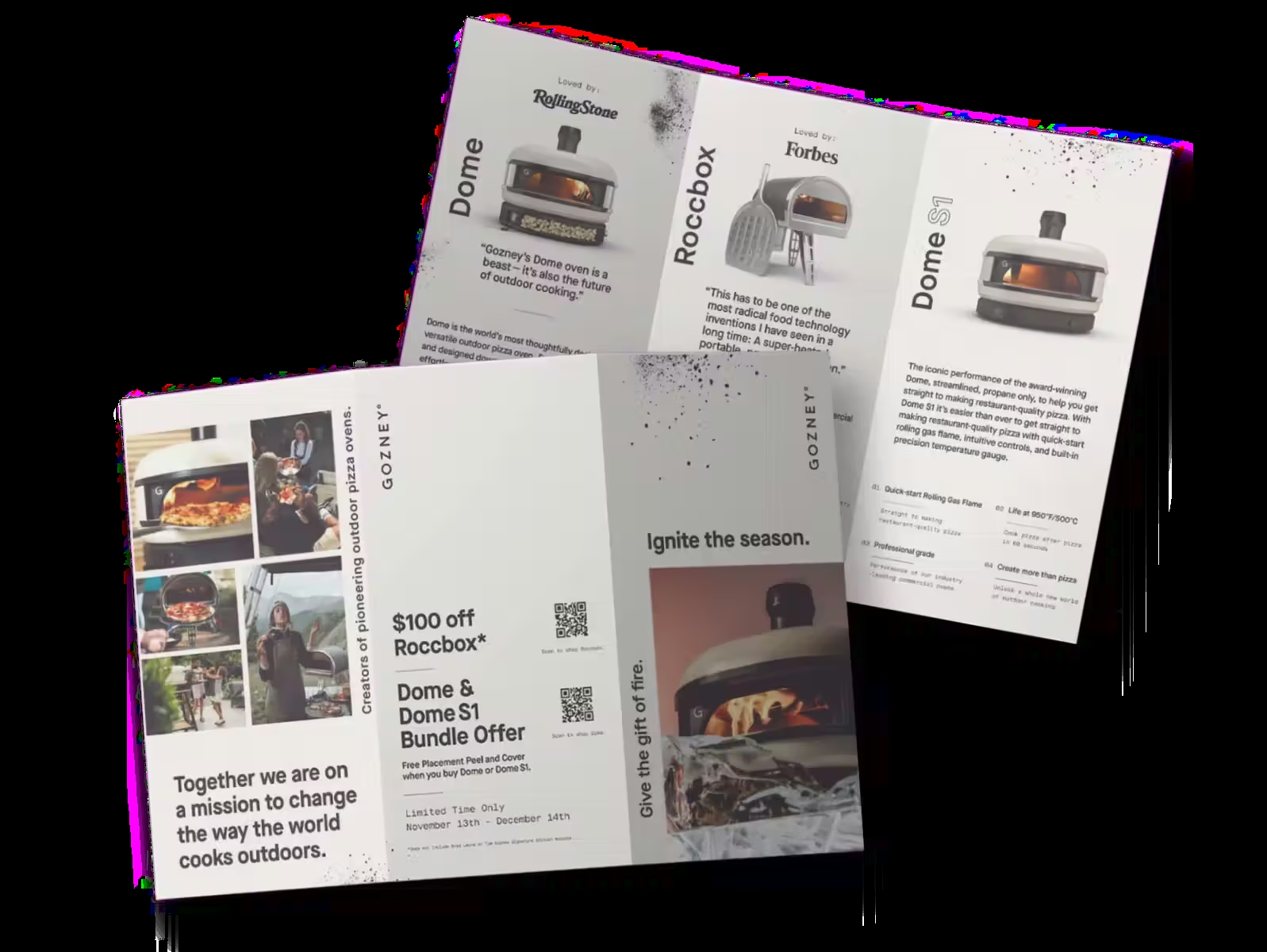
Rather than relying on a generic holiday promotion, Gozney dedicated individual panels to high-quality product imagery and descriptions. Customers could browse the ovens, understand their differences, and imagine giving one as a holiday gift.
Working with PostPilot, Gozney used SiteMatch to retarget qualified anonymous website visitors with these Cardalogs. Its broader retargeting program generated $116,000 in revenue from 151 orders and 16x reported ROAS.
The takeaway? You don't need dozens of products to create a useful gift guide. You need enough information to help someone choose between a few great options.
Sometimes, the biggest challenge with holiday shopping isn't knowing what someone would like.
It's knowing how much you want to spend.
Think about how people actually shop for gifts. They might be willing to spend $100 on their partner, $50 on a friend, and $25 on a coworker.
A gifts-by-price-point mailer helps shoppers make those decisions quickly.
Here's how we’d lay it out:
For a smaller postcard, feature one product from each category. On a larger format, show two products per price point.
Keep the categories visually distinct, with a consistent image size and clear pricing.
And don't make people do math. If a product costs $48, show $48. If a gift set starts at $75, say so.
Here's an idea: Stop organizing your gift guide around what you sell.
Start organizing it around who your customers are shopping for.
A shopper doesn't necessarily wake up thinking, "I need to buy a skincare serum."
They're thinking, "What on earth am I going to get my mom?"
Those are two very different shopping experiences.
For this holiday gift guide mailer, create gift categories around specific recipients, interests, or personalities.
A home goods brand might feature gifts for the home chef, the frequent host, and the person who just moved into a new apartment.
A beauty brand could organize its guide around the skincare enthusiast, the makeup minimalist, and the friend who deserves a little self-care.
The more recognizable the recipient, the easier it is for someone to make a connection.
How to design it: Give each recipient a small editorial-style feature with a lifestyle image, a suggested product, and one sentence explaining why it's a great gift.
Keep the descriptions conversational. "For the friend who hosts every dinner party" is much more interesting than "Kitchen accessories."
Petite Keep understands something many gift guides miss: Sometimes, you're not really selling the product. You're selling what the product represents.
The brand creates keepsake trunks designed to preserve memories, from childhood milestones to weddings and other meaningful occasions.
For its holiday direct mail campaign, Petite Keep created a trifold Cardalog built around the headline "More than a gift: an heirloom."
Inside, the mailer featured imagery showing different gifting occasions and recipients, including children and newlyweds.
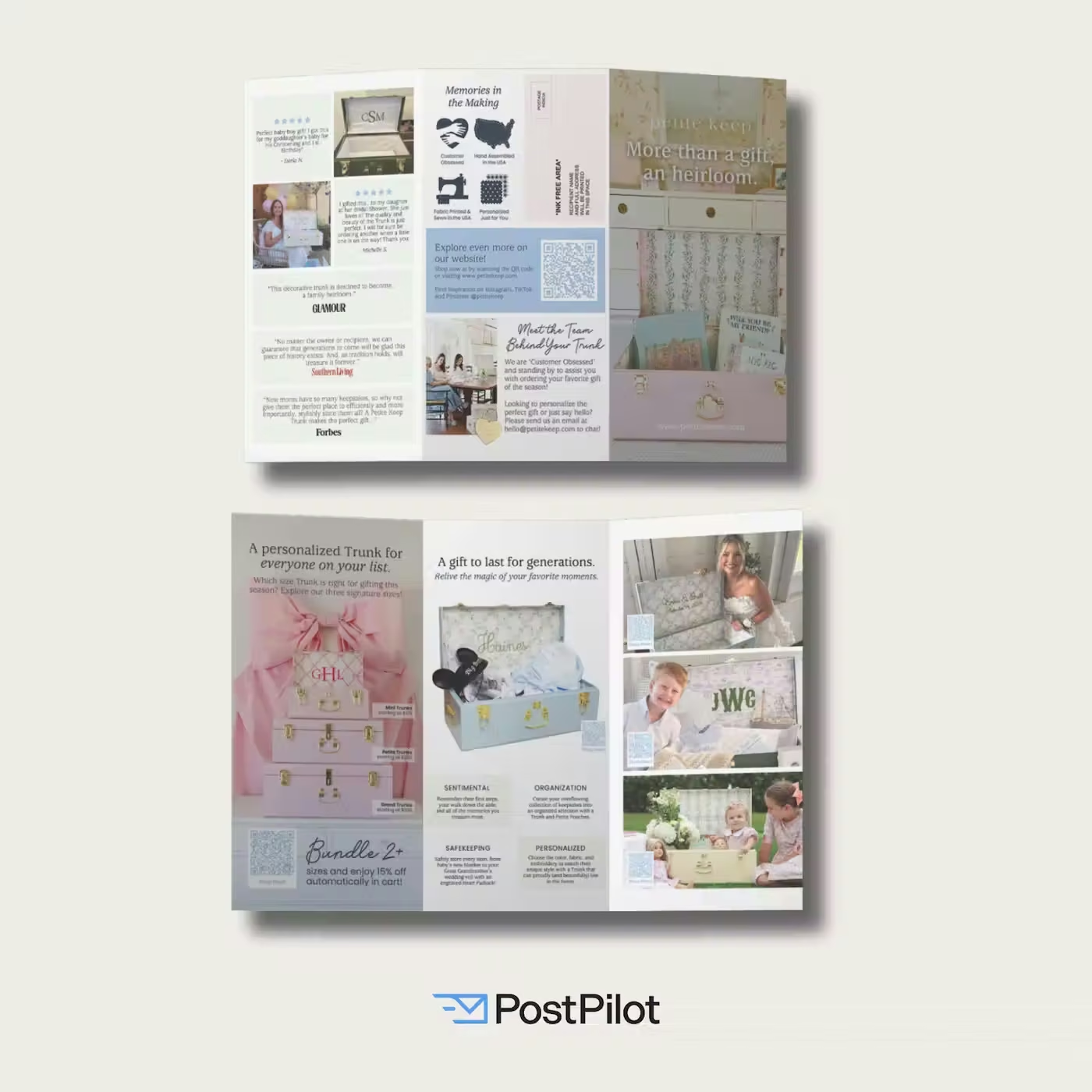
Instead of overwhelming customers with product specifications, Petite Keep helped them imagine the people who might appreciate a keepsake trunk.
The campaign generated more than 15x reported ROAS. And notably, the mailer didn't include a discount code.
The lesson: When designing your own gift guide, ask what customers are really buying. Is it convenience? A new tradition? A thoughtful gesture? A shared experience?
Build the story around that answer.
Let's say someone wants to buy a gift from your brand.
They love your products. They're willing to spend. But they don't know which items go together.
You could send them to your website and hope they figure it out.
Or you could do the work for them.
A holiday bundle guide takes individual products and packages them into ready-to-gift collections.
Think skincare routines, coffee tasting kits, matching accessories, holiday hosting essentials, or curated food collections.
The important part is explaining why the products belong together.
A bundle shouldn't feel like a random assortment of inventory you want to move. It should feel like someone thoughtfully put it together.
How to design it: Feature two or three bundles, each with a clear name, a large product image, and a short breakdown of what's included.
Saratoga Olive Oil used a holiday Cardalog to showcase a variety of gifting options, including curated bundles, artisan oils, and specialty products from different countries.
The trifold format gave the brand room to feature more products than a standard postcard while still creating a cohesive browsing experience.
The campaign specifically re-engaged one-time customers who hadn't purchased in several months.
And it worked.
Through its partnership with ECD Digital Strategy and PostPilot, Saratoga Olive Oil generated more than 13x reported ROAS on its BFCM Cardalog campaign.
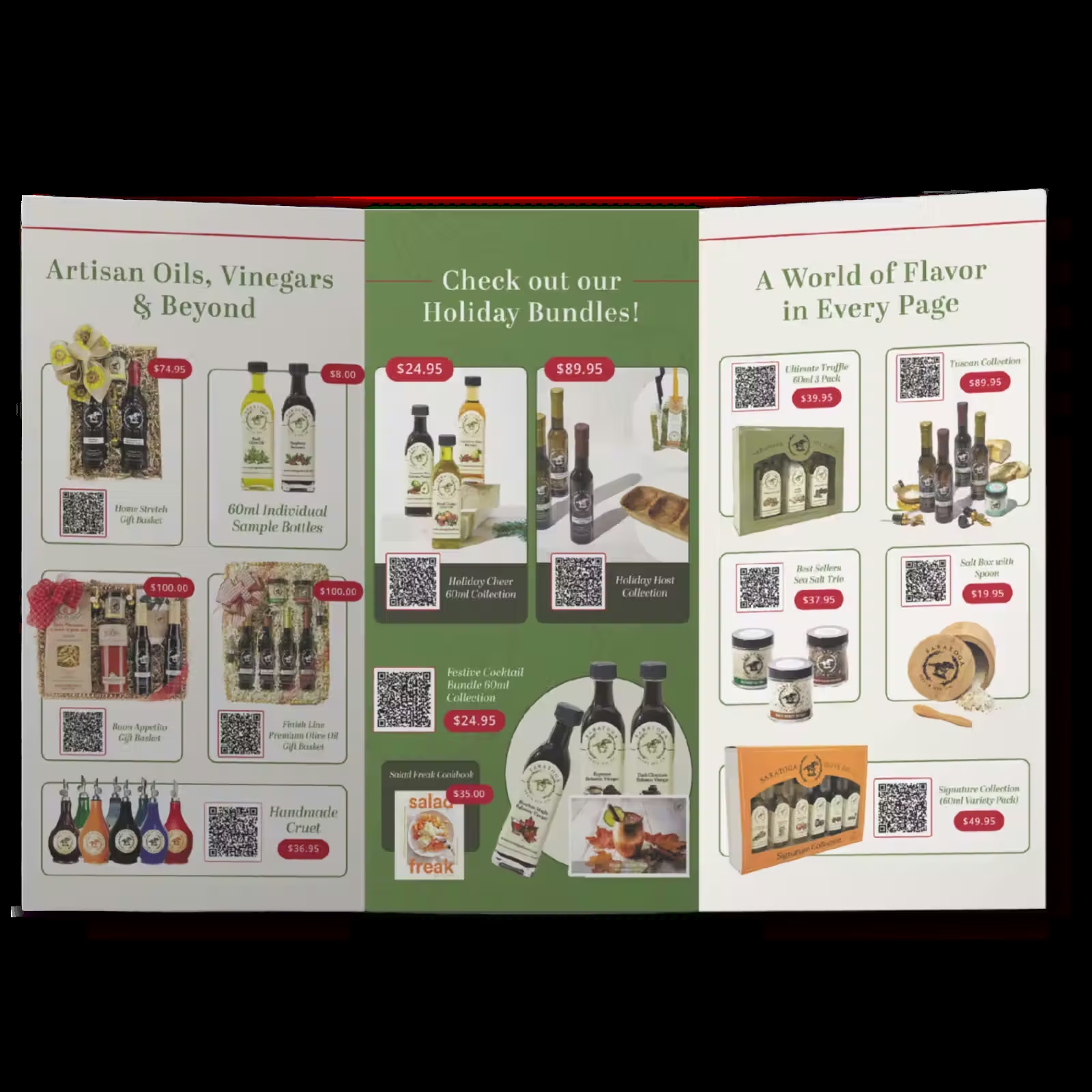
But the creative takeaway goes beyond the return.
Saratoga didn't just show customers bottles of olive oil. It presented products as collections worth exploring and, importantly, worth giving.
What to borrow: Use your holiday gift guide to merchandise combinations customers might not immediately think to create themselves.
Not every holiday purchase needs a giant red SALE sticker next to it.
For premium brands, that approach can sometimes work against the very thing that makes their products desirable.
If you're selling fine jewelry, luxury home goods, keepsakes, or high-end accessories, consider making your holiday mailer feel more like a magazine spread than a promotional flyer.
Choose one or two hero products. Invest in beautiful photography. Use short, confident copy that communicates craftsmanship, quality, or the meaning behind the gift.
And give the design room to breathe.
How to design it: Use an editorial-style layout with generous whitespace, full-bleed imagery, refined typography, and minimal promotional clutter.
We've all been there.
It's December. There's still someone on your shopping list. And you're suddenly doing mental calculations about shipping cutoffs.
A last-minute gift guide can be incredibly useful because it solves a very specific problem: What can I still buy in time?
But there's a catch with direct mail.
Unlike an email, you can't create a postcard at 9 a.m. and expect it to reach everyone's mailbox that afternoon.
That means your last-minute creative needs to be planned well in advance.
How to design it: Keep the layout extremely simple. Use one strong headline, two or three reliable gift options, and a prominent shopping deadline.
A holiday gift guide works best when customers have enough time to browse, decide, and actually receive their orders.
There are three useful mailing windows to consider.
Early holiday discovery: Send your more editorial-style gift guides ahead of the busiest shopping period. This is a good time for bestselling product collections, gifts-by-recipient guides, and Cardalogs that encourage customers to start making their lists.
Peak gift-shopping season: Focus on ready-to-gift bundles, popular gift categories, and timely promotions. Keep your featured products and shopping destinations consistent with your other holiday marketing.
Final ordering deadlines: Promote products customers can still reliably purchase, such as in-stock gifts with confirmed shipping options, pickup where available, or digital gift cards.
In accordance to our delivery guidance, campaigns typically reach full delivery saturation within 5–12 days after launch, though timing varies and isn't guaranteed.
Work backward from your desired arrival date, allowing for production and postal variability.
Another key inventory consideration for holiday print marketing: Once your mailer is printed, you can't change the products on it.
Prioritize products with reliable stock, avoid fragile pricing promises, and keep your QR-linked collection updated if something sells out.
You can always replace an unavailable product on a landing page with a relevant alternative. You can't replace the image on someone's kitchen counter.
Once your holiday postcards start arriving, you'll want to know whether people are actually shopping.
Three complementary ways to measure performance.
1. Track QR scans and landing-page visits. Use a campaign-specific URL with UTM parameters to understand how much traffic the postcard drives to your website. For scan rate, divide unique scans by delivered mailers, or clearly label the denominator as estimated deliveries if that's the data available. Scans won't capture people who type your URL or shop through another route.
2. Track unique promotional codes. If your mailer includes an offer, use a campaign-specific discount code to understand how many purchases involve that promotion. PostPilot supports static and single-use coupon tracking. Just remember that not everyone who receives a postcard will use the code.
3. Measure campaign revenue and incrementality. PostPilot's campaign reporting tracks recipient orders, revenue, conversion rate, and ROAS. With a randomized holdout group, you can also estimate how much additional revenue the mailing generated compared with customers who didn't receive it.
Make sure you're comparing the right numbers:
A QR scan tells you someone was interested. A purchase tells you someone bought something. A holdout test helps determine whether the postcard drove additional sales.
Those are different questions, and they're all worth understanding.
A useful holiday gift guide doesn't need dozens of products or a massive discount. It needs the right assortment, a compelling presentation, and an easy path to purchase.
Ready to bring your holiday merchandising ideas to life? Explore PostPilot and turn your bestselling products, holiday bundles, and gift collections into direct mail campaigns customers can actually shop.
You know the holiday gift guide. You've probably received about 20 of them already.
A grid of products. A headline about finding the perfect gift. Maybe a little ribbon graphic in the corner to make it feel festive.
And, of course, another email competing for attention in an inbox that's already overflowing with holiday promotions.
But what happens when you take that same gift guide out of the inbox and put it in someone's mailbox?
Suddenly, you're working with something your customers can hold, flip through, leave on their kitchen counter, or revisit when they're trying to figure out what to buy their impossible-to-shop-for brother.
That's the opportunity with a holiday gift guide mailer.
Instead of simply announcing a sale, a well-designed postcard can help customers discover products, compare gifting options, and find something worth purchasing. Add a QR code or memorable shopping URL to create a direct connection between physical inspiration and your online store.
The trick is knowing what deserves a spot on the postcard.
Here are six holiday direct mail ideas worth borrowing, with real examples from brands using PostPilot and practical ways to turn your own product catalog into something customers actually want to browse.
Let's start with the easiest place to find gift ideas: the products your customers already love.
Every ecommerce brand has a handful of products that consistently outperform the rest of its catalog. They're the bestsellers, the products customers reorder, and the ones that seem to show up in every other customer review.
Why not make them the stars of your holiday gift guide?
Instead of squeezing 20 products onto a postcard, choose three to five bestsellers that represent your brand particularly well.
Give each product a beautiful image, a short description, and a reason someone might want to give it as a gift.
How to design it: Use one large hero image on the front of the postcard, with three or four smaller product features on the back. Include product names, prices where appropriate, and a QR code linking to a matching collection on your website.
Pizza oven brand Gozney turned its holiday mailer into a compact product discovery experience.
Its six-panel Cardalog opened with the headline "Ignite the Season" and featured its Dome, Roccbox, and Dome S1 pizza ovens.
Rather than relying on a generic holiday promotion, Gozney dedicated individual panels to high-quality product imagery and descriptions. Customers could browse the ovens, understand their differences, and imagine giving one as a holiday gift.
Working with PostPilot, Gozney used SiteMatch to retarget qualified anonymous website visitors with these Cardalogs. Its broader retargeting program generated $116,000 in revenue from 151 orders and 16x reported ROAS.
The takeaway? You don't need dozens of products to create a useful gift guide. You need enough information to help someone choose between a few great options.
Sometimes, the biggest challenge with holiday shopping isn't knowing what someone would like.
It's knowing how much you want to spend.
Think about how people actually shop for gifts. They might be willing to spend $100 on their partner, $50 on a friend, and $25 on a coworker.
A gifts-by-price-point mailer helps shoppers make those decisions quickly.
Here's how we’d lay it out:
For a smaller postcard, feature one product from each category. On a larger format, show two products per price point.
Keep the categories visually distinct, with a consistent image size and clear pricing.
And don't make people do math. If a product costs $48, show $48. If a gift set starts at $75, say so.
Here's an idea: Stop organizing your gift guide around what you sell.
Start organizing it around who your customers are shopping for.
A shopper doesn't necessarily wake up thinking, "I need to buy a skincare serum."
They're thinking, "What on earth am I going to get my mom?"
Those are two very different shopping experiences.
For this holiday gift guide mailer, create gift categories around specific recipients, interests, or personalities.
A home goods brand might feature gifts for the home chef, the frequent host, and the person who just moved into a new apartment.
A beauty brand could organize its guide around the skincare enthusiast, the makeup minimalist, and the friend who deserves a little self-care.
The more recognizable the recipient, the easier it is for someone to make a connection.
How to design it: Give each recipient a small editorial-style feature with a lifestyle image, a suggested product, and one sentence explaining why it's a great gift.
Keep the descriptions conversational. "For the friend who hosts every dinner party" is much more interesting than "Kitchen accessories."
Petite Keep understands something many gift guides miss: Sometimes, you're not really selling the product. You're selling what the product represents.
The brand creates keepsake trunks designed to preserve memories, from childhood milestones to weddings and other meaningful occasions.
For its holiday direct mail campaign, Petite Keep created a trifold Cardalog built around the headline "More than a gift: an heirloom."
Inside, the mailer featured imagery showing different gifting occasions and recipients, including children and newlyweds.
Instead of overwhelming customers with product specifications, Petite Keep helped them imagine the people who might appreciate a keepsake trunk.
The campaign generated more than 15x reported ROAS. And notably, the mailer didn't include a discount code.
The lesson: When designing your own gift guide, ask what customers are really buying. Is it convenience? A new tradition? A thoughtful gesture? A shared experience?
Build the story around that answer.
Let's say someone wants to buy a gift from your brand.
They love your products. They're willing to spend. But they don't know which items go together.
You could send them to your website and hope they figure it out.
Or you could do the work for them.
A holiday bundle guide takes individual products and packages them into ready-to-gift collections.
Think skincare routines, coffee tasting kits, matching accessories, holiday hosting essentials, or curated food collections.
The important part is explaining why the products belong together.
A bundle shouldn't feel like a random assortment of inventory you want to move. It should feel like someone thoughtfully put it together.
How to design it: Feature two or three bundles, each with a clear name, a large product image, and a short breakdown of what's included.
Saratoga Olive Oil used a holiday Cardalog to showcase a variety of gifting options, including curated bundles, artisan oils, and specialty products from different countries.
The trifold format gave the brand room to feature more products than a standard postcard while still creating a cohesive browsing experience.
The campaign specifically re-engaged one-time customers who hadn't purchased in several months.
And it worked.
Through its partnership with ECD Digital Strategy and PostPilot, Saratoga Olive Oil generated more than 13x reported ROAS on its BFCM Cardalog campaign.
But the creative takeaway goes beyond the return.
Saratoga didn't just show customers bottles of olive oil. It presented products as collections worth exploring and, importantly, worth giving.
What to borrow: Use your holiday gift guide to merchandise combinations customers might not immediately think to create themselves.
Not every holiday purchase needs a giant red SALE sticker next to it.
For premium brands, that approach can sometimes work against the very thing that makes their products desirable.
If you're selling fine jewelry, luxury home goods, keepsakes, or high-end accessories, consider making your holiday mailer feel more like a magazine spread than a promotional flyer.
Choose one or two hero products. Invest in beautiful photography. Use short, confident copy that communicates craftsmanship, quality, or the meaning behind the gift.
And give the design room to breathe.
How to design it: Use an editorial-style layout with generous whitespace, full-bleed imagery, refined typography, and minimal promotional clutter.
We've all been there.
It's December. There's still someone on your shopping list. And you're suddenly doing mental calculations about shipping cutoffs.
A last-minute gift guide can be incredibly useful because it solves a very specific problem: What can I still buy in time?
But there's a catch with direct mail.
Unlike an email, you can't create a postcard at 9 a.m. and expect it to reach everyone's mailbox that afternoon.
That means your last-minute creative needs to be planned well in advance.
How to design it: Keep the layout extremely simple. Use one strong headline, two or three reliable gift options, and a prominent shopping deadline.
A holiday gift guide works best when customers have enough time to browse, decide, and actually receive their orders.
There are three useful mailing windows to consider.
Early holiday discovery: Send your more editorial-style gift guides ahead of the busiest shopping period. This is a good time for bestselling product collections, gifts-by-recipient guides, and Cardalogs that encourage customers to start making their lists.
Peak gift-shopping season: Focus on ready-to-gift bundles, popular gift categories, and timely promotions. Keep your featured products and shopping destinations consistent with your other holiday marketing.
Final ordering deadlines: Promote products customers can still reliably purchase, such as in-stock gifts with confirmed shipping options, pickup where available, or digital gift cards.
In accordance to our delivery guidance, campaigns typically reach full delivery saturation within 5–12 days after launch, though timing varies and isn't guaranteed.
Work backward from your desired arrival date, allowing for production and postal variability.
Another key inventory consideration for holiday print marketing: Once your mailer is printed, you can't change the products on it.
Prioritize products with reliable stock, avoid fragile pricing promises, and keep your QR-linked collection updated if something sells out.
You can always replace an unavailable product on a landing page with a relevant alternative. You can't replace the image on someone's kitchen counter.
Once your holiday postcards start arriving, you'll want to know whether people are actually shopping.
Three complementary ways to measure performance.
1. Track QR scans and landing-page visits. Use a campaign-specific URL with UTM parameters to understand how much traffic the postcard drives to your website. For scan rate, divide unique scans by delivered mailers, or clearly label the denominator as estimated deliveries if that's the data available. Scans won't capture people who type your URL or shop through another route.
2. Track unique promotional codes. If your mailer includes an offer, use a campaign-specific discount code to understand how many purchases involve that promotion. PostPilot supports static and single-use coupon tracking. Just remember that not everyone who receives a postcard will use the code.
3. Measure campaign revenue and incrementality. PostPilot's campaign reporting tracks recipient orders, revenue, conversion rate, and ROAS. With a randomized holdout group, you can also estimate how much additional revenue the mailing generated compared with customers who didn't receive it.
Make sure you're comparing the right numbers:
A QR scan tells you someone was interested. A purchase tells you someone bought something. A holdout test helps determine whether the postcard drove additional sales.
Those are different questions, and they're all worth understanding.
A useful holiday gift guide doesn't need dozens of products or a massive discount. It needs the right assortment, a compelling presentation, and an easy path to purchase.
Ready to bring your holiday merchandising ideas to life? Explore PostPilot and turn your bestselling products, holiday bundles, and gift collections into direct mail campaigns customers can actually shop.

Join thousands of ecommerce brands using PostPilot to acquire more customers & keep them coming back again (and again).
No contracts. No minimums.