
October 13, 2026
Ready to increase your revenue?
Join thousands of ecommerce brands using PostPilot to acquire more customers & keep them coming back again (and again).
No contracts. No minimums.


There’s a pretty good chance your customers are ignoring you right now.
Don’t worry, it’s not personal. Shoppers are drowning in ads, emails, texts, reels, and all the other things that ambush them the second they look at anything with a screen.
For many brands, it feels like it’s back to square one. How do you break through the digital advertising noise? The answer is to find a channel that isn’t just less saturated, but more intentional.
That’s exactly why catalog marketing is interesting again. 73% of Gen Z and Millennials actually look forward to receiving catalogs from brands.
In this article, we’ll look at real catalog marketing examples that have proven effective and show you how to apply tried-and-tested ideas to create catalogs your customers will actually be excited to receive.
Catalog marketing is the practice of sending curated product collections through direct mail to drive online purchases. Modern catalogs are highly targeted, personalized, and measurable.
Modern catalog marketing can help brands:
Another major difference? Retail catalogs are no longer just lists of products and prices. The strongest ecommerce catalogs are curated physical shopping experiences that blend lifestyle photography, product education, customer reviews, your company story, and product recommendations, all with a clear path to purchase.
With modern digital marketing feeling a little aggressive and intrusive, physical marketing provides a welcome reprieve because customers are fully in control of when and where to engage with it.
Catalogs are still receiving strong attention from customers. 92% of households spend time every day sorting through print mail to look for catalogs, and 69% of consumers say print media influenced them to choose a brand over its competitors.
It’s clear that the catalog resurgence is in full effect. But before we dive into examples of effective catalog marketing strategies, it’s important to explore why this resurgence is happening.
Search ads and social ads primarily rely on customers already showing intent. Catalogs, on the other hand, open up a whole physical world that introduces customers to products they may not have discovered otherwise, generating demand as a result.
USPS found that 71% of consumers who received a catalog had their purchase decision influenced by it, showing that catalogs can be a powerful tool to move customers from browsing to purchasing.
You no longer have to send your catalog out with a well-meaning kid on a bike and hope for the best.
Unlike the old days, modern catalog campaigns are much easier to track and measure. Ecommerce brands can connect direct mail campaigns to online purchases using personalized URLs, QR codes, unique discount codes, or customer-level attribution.
The result is a channel that can be evaluated using the same performance metrics brands use for digital marketing, such as:
Look, we love catalogs too, but it’s important to make sure your pendulum doesn’t swing too far in the other direction: the strongest ecommerce brands aren’t replacing their digital marketing with catalog campaigns. They’re adding catalogs as another touchpoint in the customer journey alongside email, SMS, and social.
A catalog acts as an important initial physical interaction that sends customers online to browse further and complete their purchase. This combination of digital and physical allows brands to reach customers in multiple environments, instead of competing for attention in one channel. It resonates with Gen Z and Millennial customers too: 78% of them appreciate when a brand enhances physical shopping with digital touchpoints.
It’s easy to get excited about seeing your products beautifully laid out in a catalog. But the best catalogs are more than pretty product galleries. They’re tactile shopping experiences that inspire customers to browse, imagine, and eventually make their way online to complete a purchase.
Take a look, get inspired, and steal these five catalog marketing ideas for your next campaign.
Cozy Earth is more than comfortable with their catalog marketing strategy. You might even say they’re… cozy with it?
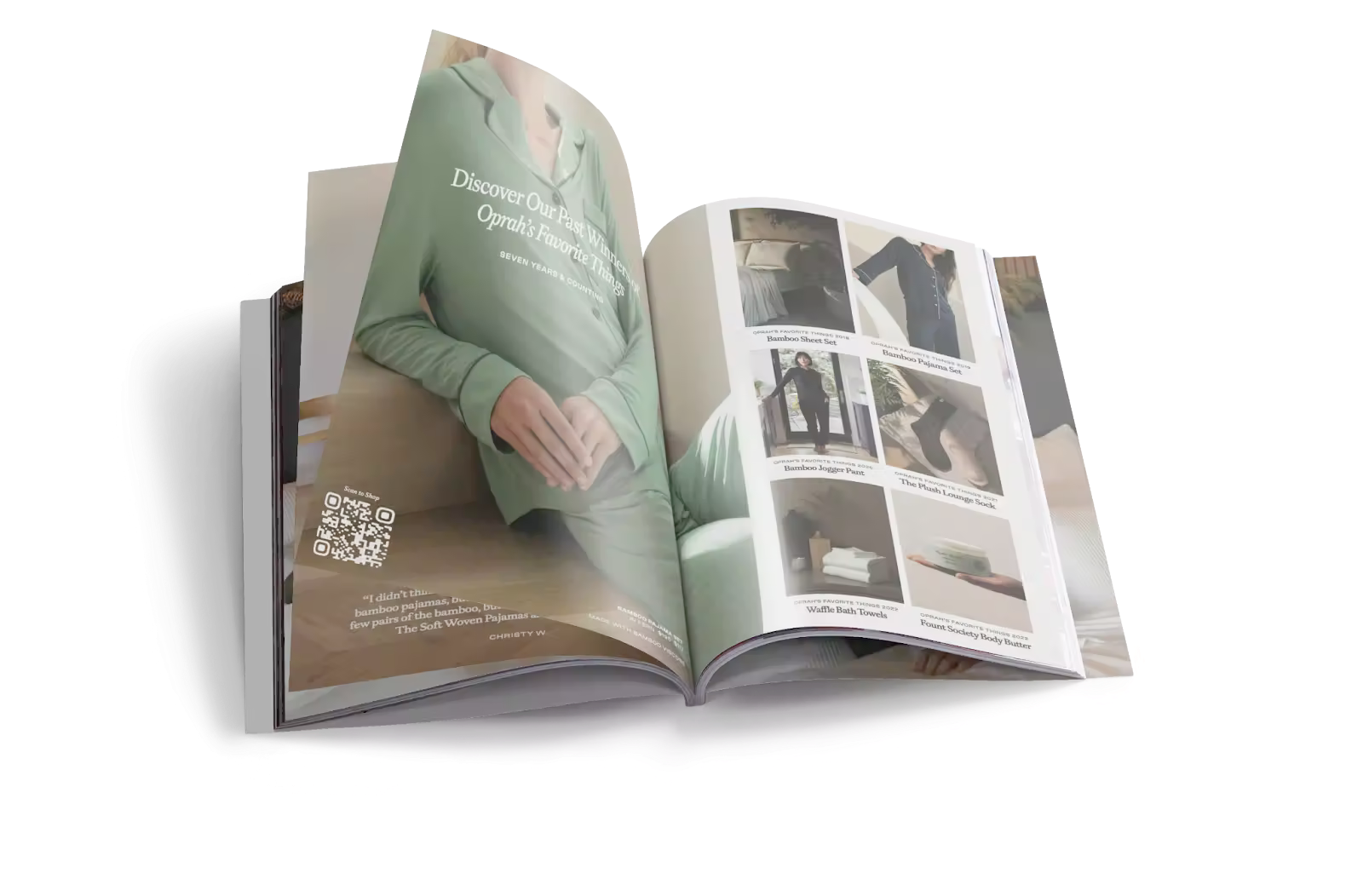
The team at Cozy Earth uses high-quality lifestyle photography and minimal text to create a catalog that shows customers what their best life could look like. This approach lets the products do the talking, highlighting them in carefully curated environments like spa-like bathrooms and sunlit bedrooms.
When exploring a photo-first approach like Cozy Earth, avoid product photography that is strictly just the product. A catalog with a giant picture of a purse, for example, is simply not exciting.
Instead, show your products in use. Think: models wearing your apparel, cookware being used in the kitchen, or a granola bar being eaten on the go.
With PostPilot handling the prospecting, designing, and printing, Cozy Earth cut their lead time from 5–6 months to just 5 weeks. Plus, their prospecting campaigns achieved up to 7.71x incremental ROAS.
Catalogs shouldn’t take 6 months. And they don’t have to! We feel so strongly about this that we wrote a whole article about it. Give it a read to learn more about shortening your lead time and cleaning up your direct mail game.
With 64% of American consumers saying printed catalogs make them feel more informed, HexClad’s catalog approach is to demonstrate why a kitchen isn’t complete without their products is an iron-clad example of how catalog marketing can educate and engage.
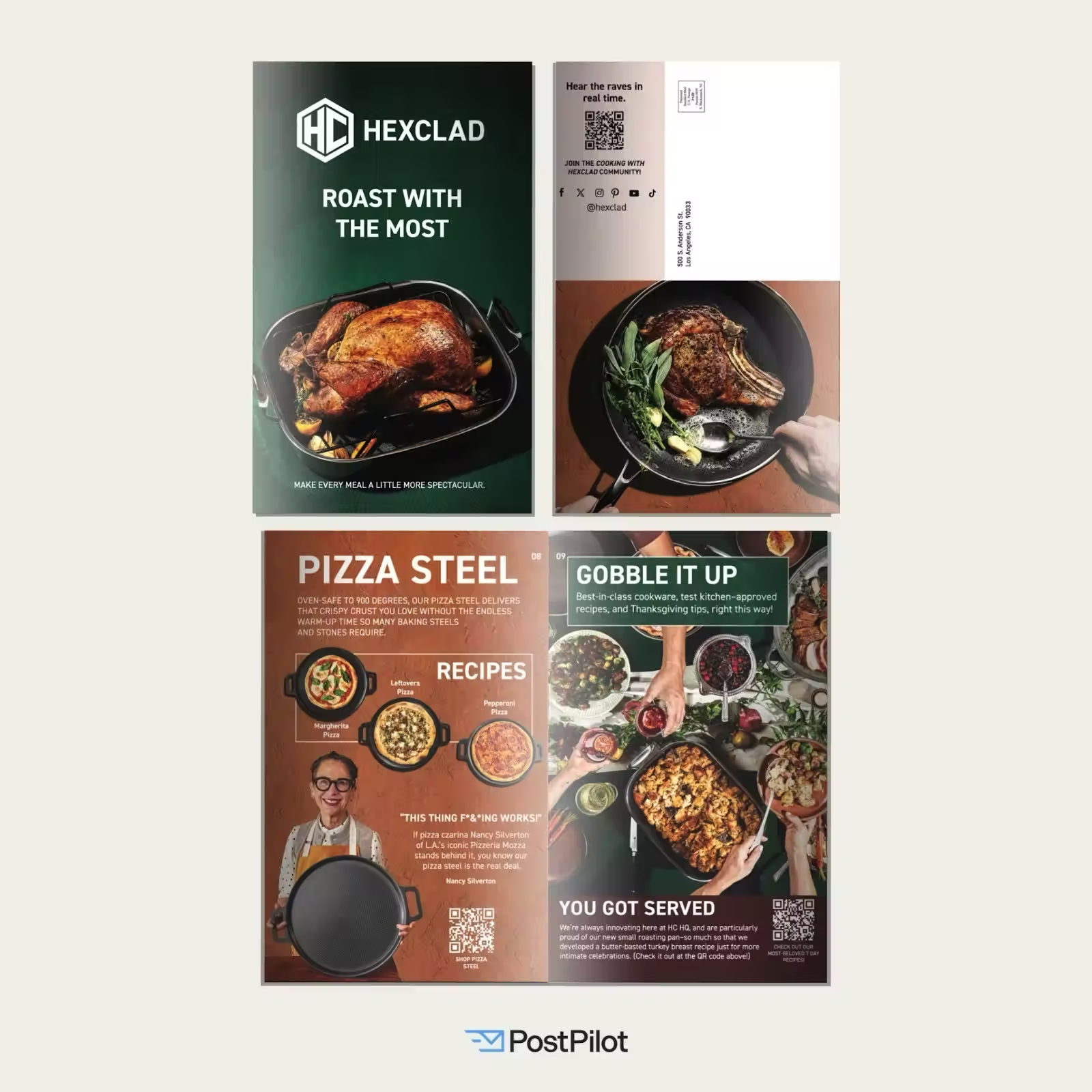
HexClad divides their catalog into 3 sections: pans, steels, and Thanksgiving imagery. This simple setup makes their story light, easy to follow, and much more engaging than just a list of their products.
For brands with major product catalogs and tons of incredible product imagery
Innovate with your design – don’t just recreate your website. Take advantage of the folded format to entice, educate, and reinforce your brand as the solution to the customer’s problem.
Offer something unique that gives them a reason to read your catalog. Otherwise, they could just go to your website and see the same thing.
HexClad sent Cardalogs to customers who last ordered 1.5 years ago as part of a winback campaign. And win them back they did: the campaign resulted in a 2.87x iROAS.
Alongside their successful Cardalog campaign, HexClad has seen success with mini catalogs as well. This short video shows how they used that medium to effectively highlight their products, customer testimonials, and more.
Mizzen+Main offers classic style with modern performance, so it makes perfect sense that they gave email (un)subscribers a classic-yet-modern way to interact with their brand.

Mizzen+Main wanted to win back customers who had unsubscribed from their email list, so they promoted their new Fall Collection using a sleek Modern Catalog full of high-quality visuals showing products both on models and as product shots, with carefully designed, vibrant backgrounds.
Working with PostPilot, the multi-page catalog was built and delivered in just 6 weeks, ensuring timely delivery for the Fall Collection campaign.
Segmentation is key when it comes to catalogs. Don’t send the same catalog to every customer regardless of their relationship with your brand. Instead, design each catalog to serve a specific purpose. Your winback catalog should look a lot different than the ones you send to VIPs.
While these customers may have initially unsubscribed, it didn’t take long for them to find their way back into Mizzen+Main’s ecosystem: the catalog campaign saw a 6.8–8.15x ROAS.
For Love & Lemons creates beautiful, elegant apparel, so they understandably wanted a catalog that felt like an extension of their brand.
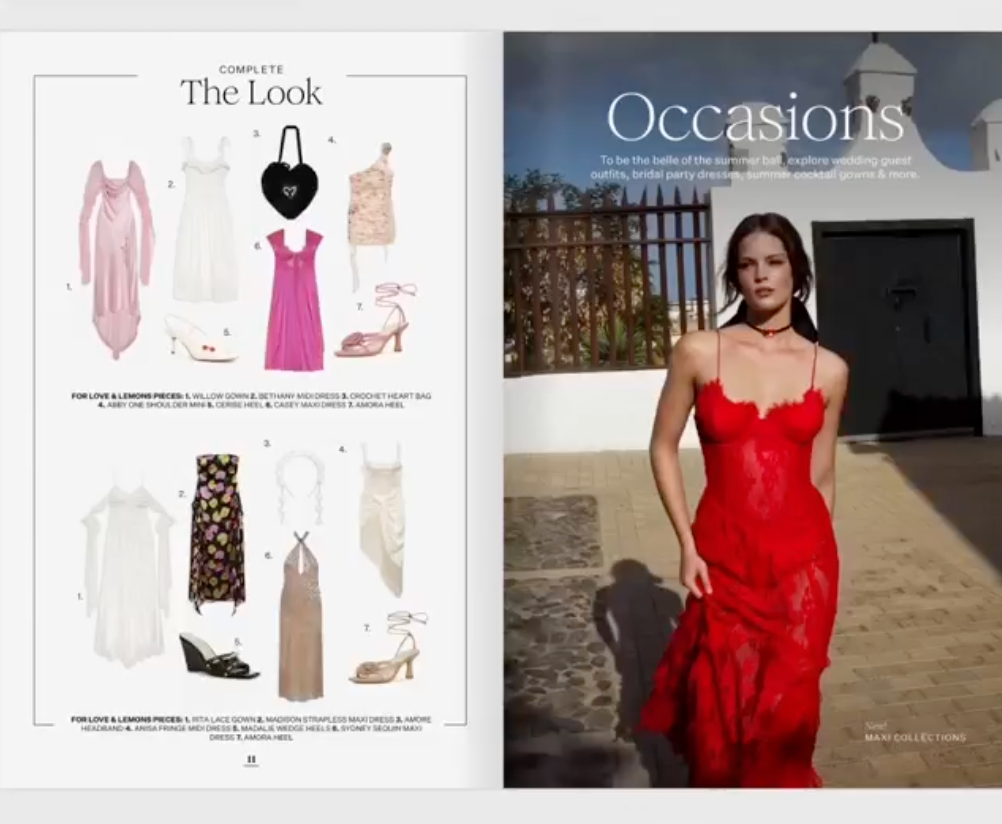
For Love & Lemons’ magazine-style catalog highlighted products by showing complete outfits rather than individual items, making it easier for customers to imagine how the pieces work together. This strategy also subtly encourages multi-product purchases by giving shoppers a full look they can replicate.
By highlighting multiple products in this simple, cohesive fashion, brands can show more products at once without the catalog ever feeling overstuffed.
Think like a customer, not an inventory manager. When using this strategy, avoid organizing the catalog around internal categories like “dresses,” “shoes,” and “accessories.” Instead, build your catalog around how your customers actually shop.
Feeling inspired after reading through the catalog examples above? Set yourself up for retail catalog success by following these tips used by brands like the ones we just covered.
A standalone product shot isn’t always the best play, no matter how attractive your product may be. Show your products in real-life settings so customers can picture how they’ll actually fit into their homes, wardrobes, or routines.
We get it: your products are awesome, and you have a lot to say. But less is truly more. Customers skim catalogs. They don’t read every word. Lead with the value being offered so you can maintain their attention from page to page.
Your catalog is an extension of your brand, so don’t take up valuable space with excess inventory you’re trying to offload. Instead, guide shoppers to proven favorites by highlighting your best sellers and hero products.
Shoppers likely don’t think about your product groupings the same way you do. They think in terms of outfits, occasions, rooms, and routines – not “tops,” “accessories,” or “home decor.” Group products around how they’ll be used together, not how they’re categorized in your backend.
At the end of the day, your brand copy can only go so far. Of course you’re going to claim your product is great! Give customers a deeper reason to trust your products by showing real testimonials and customer ratings.
Every segment has its own needs, and catalog marketing isn’t a one-size-fits-all approach. Experiment with different formats, layouts, imagery, and more to learn which combinations drive the strongest response from specific segments.
The beauty of modern catalog marketing is in the measurability. Track sales, ROAS, and customer behavior after each campaign so you can optimize and fine-tune over time.
With customers trained to ignore every ad that pops up on one of their many devices, catalogs remain one of the best ways to break through the digital noise. But sending any old catalog doesn’t mean instant success. The best catalog marketing campaigns do more than showcase products; they create experiences customers actually want to spend time with.
Interested in taking the plunge but need a little more inspiration? We won’t leave you hanging! Browse the PostPilot Design Studio for an ever-growing library of high-performing direct mail examples including catalogs, Cardalogs, postcards, and other campaigns used by thousands of real Shopify brands like yours.
Effective catalog marketing campaigns go beyond simple product listings. They create a shopping experience that customers will remember. Examples include lifestyle-focused catalogs, educational catalogs, curated product collections, and targeted catalogs used for retargeting/winback campaigns.
Successful catalog marketing involves smart experimentation and an understanding of your customers. Focus on sending catalogs to the right audience, merchandising products around customer needs, and using compelling visuals and benefit-driven copy. Measuring campaign performance and testing different formats, offers, and customer segments will help improve results over time.
Ecommerce brands are shifting toward smaller, more targeted catalogs, personalized product recommendations, and omnichannel campaigns connecting direct mail with digital marketing.
Design tools like Canva are popular for creating catalogs, while platforms like Issuu and Flipsnack help publish digital versions online. For Shopify brands looking to launch direct mail catalog campaigns, platforms like PostPilot combine catalog production with audience targeting, automation, and revenue attribution.
There’s a pretty good chance your customers are ignoring you right now.
Don’t worry, it’s not personal. Shoppers are drowning in ads, emails, texts, reels, and all the other things that ambush them the second they look at anything with a screen.
For many brands, it feels like it’s back to square one. How do you break through the digital advertising noise? The answer is to find a channel that isn’t just less saturated, but more intentional.
That’s exactly why catalog marketing is interesting again. 73% of Gen Z and Millennials actually look forward to receiving catalogs from brands.
In this article, we’ll look at real catalog marketing examples that have proven effective and show you how to apply tried-and-tested ideas to create catalogs your customers will actually be excited to receive.
Catalog marketing is the practice of sending curated product collections through direct mail to drive online purchases. Modern catalogs are highly targeted, personalized, and measurable.
Modern catalog marketing can help brands:
Another major difference? Retail catalogs are no longer just lists of products and prices. The strongest ecommerce catalogs are curated physical shopping experiences that blend lifestyle photography, product education, customer reviews, your company story, and product recommendations, all with a clear path to purchase.
With modern digital marketing feeling a little aggressive and intrusive, physical marketing provides a welcome reprieve because customers are fully in control of when and where to engage with it.
Catalogs are still receiving strong attention from customers. 92% of households spend time every day sorting through print mail to look for catalogs, and 69% of consumers say print media influenced them to choose a brand over its competitors.
It’s clear that the catalog resurgence is in full effect. But before we dive into examples of effective catalog marketing strategies, it’s important to explore why this resurgence is happening.
Search ads and social ads primarily rely on customers already showing intent. Catalogs, on the other hand, open up a whole physical world that introduces customers to products they may not have discovered otherwise, generating demand as a result.
USPS found that 71% of consumers who received a catalog had their purchase decision influenced by it, showing that catalogs can be a powerful tool to move customers from browsing to purchasing.
You no longer have to send your catalog out with a well-meaning kid on a bike and hope for the best.
Unlike the old days, modern catalog campaigns are much easier to track and measure. Ecommerce brands can connect direct mail campaigns to online purchases using personalized URLs, QR codes, unique discount codes, or customer-level attribution.
The result is a channel that can be evaluated using the same performance metrics brands use for digital marketing, such as:
Look, we love catalogs too, but it’s important to make sure your pendulum doesn’t swing too far in the other direction: the strongest ecommerce brands aren’t replacing their digital marketing with catalog campaigns. They’re adding catalogs as another touchpoint in the customer journey alongside email, SMS, and social.
A catalog acts as an important initial physical interaction that sends customers online to browse further and complete their purchase. This combination of digital and physical allows brands to reach customers in multiple environments, instead of competing for attention in one channel. It resonates with Gen Z and Millennial customers too: 78% of them appreciate when a brand enhances physical shopping with digital touchpoints.
It’s easy to get excited about seeing your products beautifully laid out in a catalog. But the best catalogs are more than pretty product galleries. They’re tactile shopping experiences that inspire customers to browse, imagine, and eventually make their way online to complete a purchase.
Take a look, get inspired, and steal these five catalog marketing ideas for your next campaign.
Cozy Earth is more than comfortable with their catalog marketing strategy. You might even say they’re… cozy with it?
The team at Cozy Earth uses high-quality lifestyle photography and minimal text to create a catalog that shows customers what their best life could look like. This approach lets the products do the talking, highlighting them in carefully curated environments like spa-like bathrooms and sunlit bedrooms.
When exploring a photo-first approach like Cozy Earth, avoid product photography that is strictly just the product. A catalog with a giant picture of a purse, for example, is simply not exciting.
Instead, show your products in use. Think: models wearing your apparel, cookware being used in the kitchen, or a granola bar being eaten on the go.
With PostPilot handling the prospecting, designing, and printing, Cozy Earth cut their lead time from 5–6 months to just 5 weeks. Plus, their prospecting campaigns achieved up to 7.71x incremental ROAS.
Catalogs shouldn’t take 6 months. And they don’t have to! We feel so strongly about this that we wrote a whole article about it. Give it a read to learn more about shortening your lead time and cleaning up your direct mail game.
With 64% of American consumers saying printed catalogs make them feel more informed, HexClad’s catalog approach is to demonstrate why a kitchen isn’t complete without their products is an iron-clad example of how catalog marketing can educate and engage.
HexClad divides their catalog into 3 sections: pans, steels, and Thanksgiving imagery. This simple setup makes their story light, easy to follow, and much more engaging than just a list of their products.
For brands with major product catalogs and tons of incredible product imagery
Innovate with your design – don’t just recreate your website. Take advantage of the folded format to entice, educate, and reinforce your brand as the solution to the customer’s problem.
Offer something unique that gives them a reason to read your catalog. Otherwise, they could just go to your website and see the same thing.
HexClad sent Cardalogs to customers who last ordered 1.5 years ago as part of a winback campaign. And win them back they did: the campaign resulted in a 2.87x iROAS.
Alongside their successful Cardalog campaign, HexClad has seen success with mini catalogs as well. This short video shows how they used that medium to effectively highlight their products, customer testimonials, and more.
Mizzen+Main offers classic style with modern performance, so it makes perfect sense that they gave email (un)subscribers a classic-yet-modern way to interact with their brand.
Mizzen+Main wanted to win back customers who had unsubscribed from their email list, so they promoted their new Fall Collection using a sleek Modern Catalog full of high-quality visuals showing products both on models and as product shots, with carefully designed, vibrant backgrounds.
Working with PostPilot, the multi-page catalog was built and delivered in just 6 weeks, ensuring timely delivery for the Fall Collection campaign.
Segmentation is key when it comes to catalogs. Don’t send the same catalog to every customer regardless of their relationship with your brand. Instead, design each catalog to serve a specific purpose. Your winback catalog should look a lot different than the ones you send to VIPs.
While these customers may have initially unsubscribed, it didn’t take long for them to find their way back into Mizzen+Main’s ecosystem: the catalog campaign saw a 6.8–8.15x ROAS.
For Love & Lemons creates beautiful, elegant apparel, so they understandably wanted a catalog that felt like an extension of their brand.
For Love & Lemons’ magazine-style catalog highlighted products by showing complete outfits rather than individual items, making it easier for customers to imagine how the pieces work together. This strategy also subtly encourages multi-product purchases by giving shoppers a full look they can replicate.
By highlighting multiple products in this simple, cohesive fashion, brands can show more products at once without the catalog ever feeling overstuffed.
Think like a customer, not an inventory manager. When using this strategy, avoid organizing the catalog around internal categories like “dresses,” “shoes,” and “accessories.” Instead, build your catalog around how your customers actually shop.
Feeling inspired after reading through the catalog examples above? Set yourself up for retail catalog success by following these tips used by brands like the ones we just covered.
A standalone product shot isn’t always the best play, no matter how attractive your product may be. Show your products in real-life settings so customers can picture how they’ll actually fit into their homes, wardrobes, or routines.
We get it: your products are awesome, and you have a lot to say. But less is truly more. Customers skim catalogs. They don’t read every word. Lead with the value being offered so you can maintain their attention from page to page.
Your catalog is an extension of your brand, so don’t take up valuable space with excess inventory you’re trying to offload. Instead, guide shoppers to proven favorites by highlighting your best sellers and hero products.
Shoppers likely don’t think about your product groupings the same way you do. They think in terms of outfits, occasions, rooms, and routines – not “tops,” “accessories,” or “home decor.” Group products around how they’ll be used together, not how they’re categorized in your backend.
At the end of the day, your brand copy can only go so far. Of course you’re going to claim your product is great! Give customers a deeper reason to trust your products by showing real testimonials and customer ratings.
Every segment has its own needs, and catalog marketing isn’t a one-size-fits-all approach. Experiment with different formats, layouts, imagery, and more to learn which combinations drive the strongest response from specific segments.
The beauty of modern catalog marketing is in the measurability. Track sales, ROAS, and customer behavior after each campaign so you can optimize and fine-tune over time.
With customers trained to ignore every ad that pops up on one of their many devices, catalogs remain one of the best ways to break through the digital noise. But sending any old catalog doesn’t mean instant success. The best catalog marketing campaigns do more than showcase products; they create experiences customers actually want to spend time with.
Interested in taking the plunge but need a little more inspiration? We won’t leave you hanging! Browse the PostPilot Design Studio for an ever-growing library of high-performing direct mail examples including catalogs, Cardalogs, postcards, and other campaigns used by thousands of real Shopify brands like yours.
Effective catalog marketing campaigns go beyond simple product listings. They create a shopping experience that customers will remember. Examples include lifestyle-focused catalogs, educational catalogs, curated product collections, and targeted catalogs used for retargeting/winback campaigns.
Successful catalog marketing involves smart experimentation and an understanding of your customers. Focus on sending catalogs to the right audience, merchandising products around customer needs, and using compelling visuals and benefit-driven copy. Measuring campaign performance and testing different formats, offers, and customer segments will help improve results over time.
Ecommerce brands are shifting toward smaller, more targeted catalogs, personalized product recommendations, and omnichannel campaigns connecting direct mail with digital marketing.
Design tools like Canva are popular for creating catalogs, while platforms like Issuu and Flipsnack help publish digital versions online. For Shopify brands looking to launch direct mail catalog campaigns, platforms like PostPilot combine catalog production with audience targeting, automation, and revenue attribution.

Join thousands of ecommerce brands using PostPilot to acquire more customers & keep them coming back again (and again).
No contracts. No minimums.