
October 27, 2026
Ready to increase your revenue?
Join thousands of ecommerce brands using PostPilot to acquire more customers & keep them coming back again (and again).
No contracts. No minimums.


Shopify's 2026 holiday research says 65% of shoppers plan to use AI for at least one shopping task this season.
For many brands, that means a lot of first orders from people who described a problem to a chatbot and got your product back.
The agent found you in November. In March, it can just as easily find someone else.
But the brands that show up in the customer's home after delivery get order two.
Shopify is calling this the first holiday season of the agentic era. Per its 2026 Global Holiday Retail Report, 65% of shoppers say they'll use AI for at least one shopping task this season.
The better news for anyone outside the big-box aisle: 71% of regular AI users say they're more likely to choose an indie brand this year than last.
Shopify's merchants are already seeing it in their numbers.
According to Shopify, Stanley 1913 saw five times as many AI-referred US orders as the same window last year, and Cottonique's AI-referred sales grew 276% year over year.
One more detail from the report matters for everything below. Only about one-third of shoppers say they've trusted an AI agent to buy on their behalf. So the agent does the research, and the shopper makes the call.
An agent-referred first order arrives with thin brand memory.
The customer remembers asking ChatGPT for "a gift for my sister who runs." They don't remember the name of the shop it picked.
It's a step removed from the initial brand experience exercise that's been the Way of DTC for a couple decades at this point. You search, you research, you browse, you compare, you think, you buy.
In this case, though, when these shoppers need something again, they'll ask the agent again. And the agent has no loyalty to you. It won't even send you a Christmas card.
(How rude!)
What's worse is that BFCM first-time buyers were already the hardest group to bring back. They showed up for a discount, during the loudest week of the year. Basically, price is king, and there's no other royalty.
Now stack an AI middleman on top.
A discount-driven, low-memory, agent-referred first order is about as loosely attached as a customer gets.
And that sucks.
Your post-purchase flow still fires in December.
It lands next to dozens of other brands' promos, several of them also saying thank you.
(Gratitude gets competitive in December.)
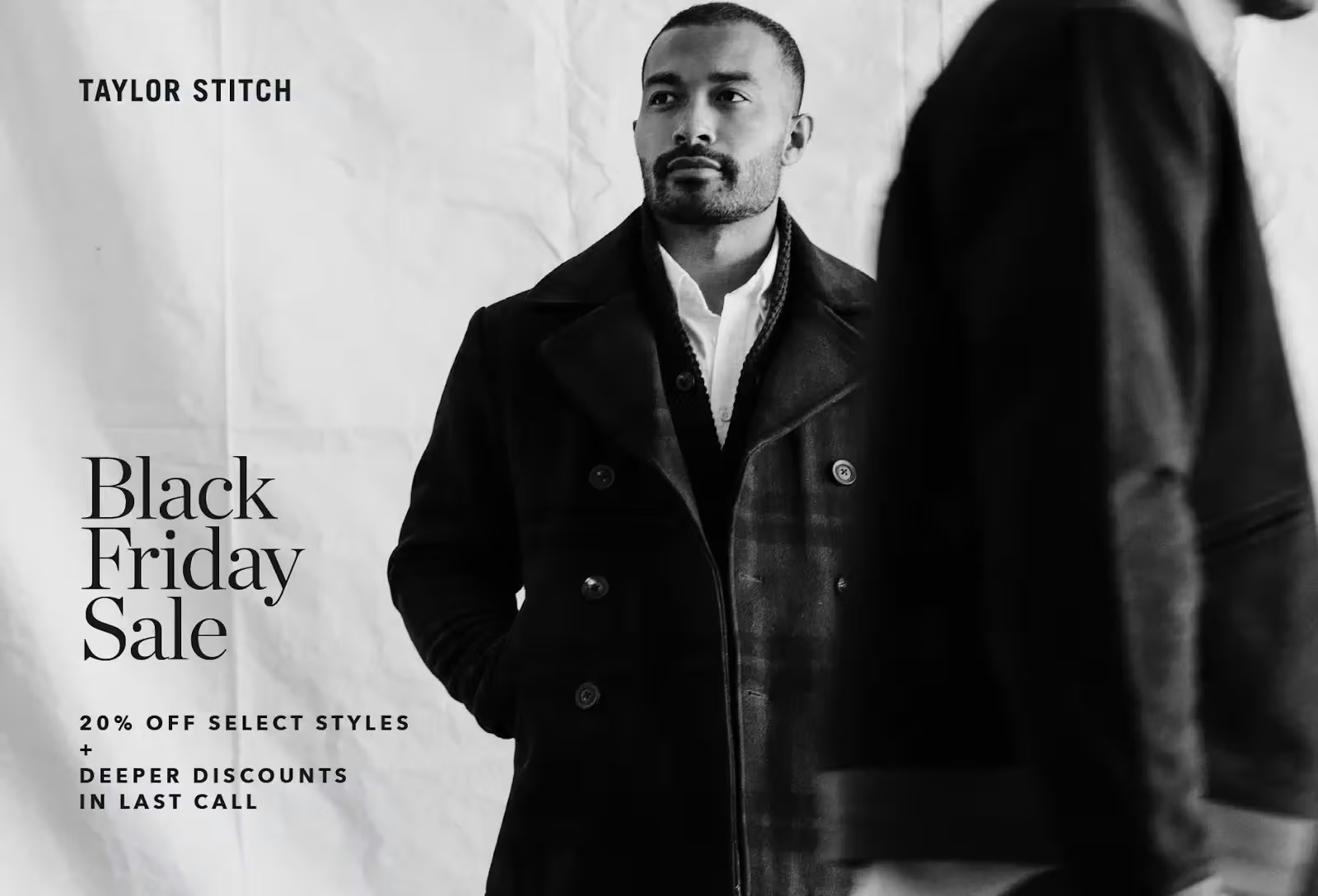
Taylor Stitch saw this up close. Over BFCM, the team mailed a postcard to email subscribers who had received its BFCM emails "0 times," plus a segment with multiple bounces. Those were people completely missing digital messages, and postcards became a major revenue driver for that group.
TO BE CLEAR...
Keep your email flows running.
But adding a postcard or two covers the customers your emails aren't landing with and reinforces the ones they are.
It also sticks around. A postcard sits on the kitchen counter for days, where the whole household sees it, long after December's promo emails have been archived in bulk.
Here's how to set it up: a post-delivery postcard to your BFCM first-time buyers.
Think of it as a bounce-back offer with one specific job: turn an agent-referred first order into a direct relationship before the agent gets another turn.
Build a segment of customers whose first order landed in the BFCM window and who have exactly one order. You can build it from your Klaviyo list or straight from Shopify order data.
(If you haven't paired the two channels yet, here's how postcards with Klaviyo work.)
Match the window to your own promo calendar. If your Black Friday sale opened the week before Thanksgiving (whose didn't?), start the segment there.
After the order arrives, while the product is in their hands. That's when they're using what you sold them and your name is still attached to it.
We recommend triggering the card when the order ships. Postcards usually land one to two weeks after they're triggered, so yours shows up after the box does.
Lead with your hero product.
MaryRuth’s automated exactly this. The brand fires off a cross-sell card to customers who haven’t bought its hero product, Liquid Morning Multivitamin, and puts that bottle front and center (next to some very tempting fruit).
Those cross-sells drove 2.2x incremental ROAS on Shopify and 8x ROAS on Amazon.

Test an offer against no offer. Your margins already took a hit over BFCM (you've seen the P&L), and some customers will come back without another discount.
Taylor Stitch has tested offers against non-discount messaging across recency and frequency segments. As the team put it: "In a number of cases, the non-discounted message has actually resulted in a higher incremental lift at a higher margin."
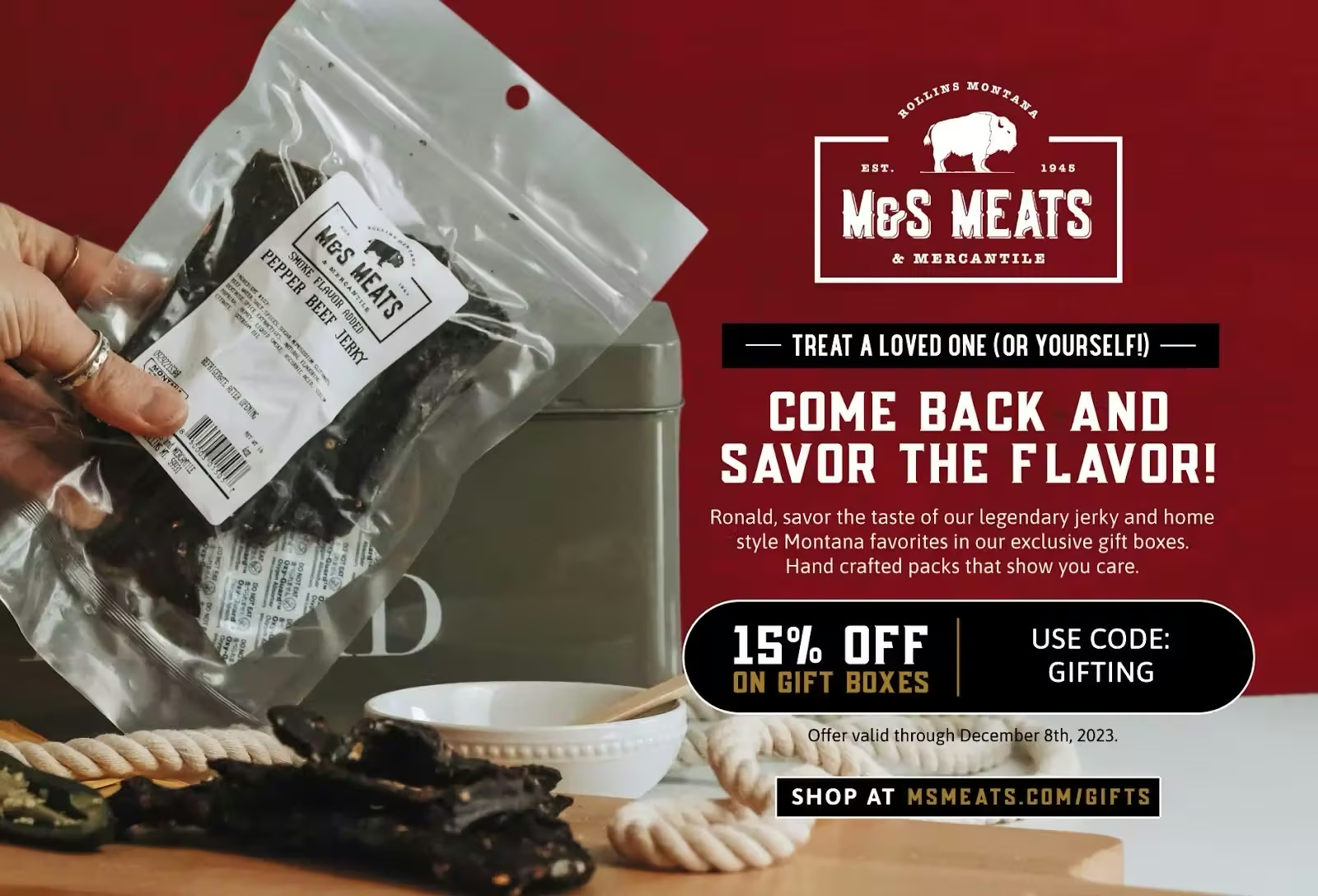
M&S Meats saw the same thing over BFCM. The brand mailed past gift buyers, split into four segments by recency and frequency, with 15% off gift boxes.
Plenty of them skipped the code entirely and bought other products at full price. (That's the kind of second order a CFO frames.)
PostPilot was "crucial" to the brand's 2x year-over-year holiday revenue. Read the M&S Meats case study.
Set this up as an automation. Every BFCM first-timer who qualifies gets a card when they enter the segment, and nobody has to remember to pull a list in January.
That's the whole point of automated customer retention: the program runs while your team is recovering from Cyber Week (and the leftover pie). Taylor Stitch runs its winbacks this way, and those automations have seen 15x+ ROI per campaign.
If you want clean incrementality, run a holdout on this campaign. A holdout is a choice you make per campaign: a random slice of the segment gets no card, and the gap in purchases between the two groups is your lift.
PostPilot's significance check needs at least 1,000 customers in each group. If your BFCM first-timer segment is smaller, let the automation run longer before you read the result.
AI discovery is a gift for indie brands this season. Take every first order it sends you.
The profit lives in the second order, and the agent has no reason to send that one your way. That's the job of direct mail for retention.
PostPilot plugs into Klaviyo and Shopify, builds the BFCM first-time-buyer segment inside the app, designs the card and fires it automatically when a customer qualifies. The agent made the introduction.
The postcard on the counter is how they remember your name in March.
Get the card in place before the orders start landing.
Book a demo and we'll help you set up your BFCM first-time-buyer postcard.
Shopify's 2026 holiday research says 65% of shoppers plan to use AI for at least one shopping task this season.
For many brands, that means a lot of first orders from people who described a problem to a chatbot and got your product back.
The agent found you in November. In March, it can just as easily find someone else.
But the brands that show up in the customer's home after delivery get order two.
Shopify is calling this the first holiday season of the agentic era. Per its 2026 Global Holiday Retail Report, 65% of shoppers say they'll use AI for at least one shopping task this season.
The better news for anyone outside the big-box aisle: 71% of regular AI users say they're more likely to choose an indie brand this year than last.
Shopify's merchants are already seeing it in their numbers.
According to Shopify, Stanley 1913 saw five times as many AI-referred US orders as the same window last year, and Cottonique's AI-referred sales grew 276% year over year.
One more detail from the report matters for everything below. Only about one-third of shoppers say they've trusted an AI agent to buy on their behalf. So the agent does the research, and the shopper makes the call.
An agent-referred first order arrives with thin brand memory.
The customer remembers asking ChatGPT for "a gift for my sister who runs." They don't remember the name of the shop it picked.
It's a step removed from the initial brand experience exercise that's been the Way of DTC for a couple decades at this point. You search, you research, you browse, you compare, you think, you buy.
In this case, though, when these shoppers need something again, they'll ask the agent again. And the agent has no loyalty to you. It won't even send you a Christmas card.
(How rude!)
What's worse is that BFCM first-time buyers were already the hardest group to bring back. They showed up for a discount, during the loudest week of the year. Basically, price is king, and there's no other royalty.
Now stack an AI middleman on top.
A discount-driven, low-memory, agent-referred first order is about as loosely attached as a customer gets.
And that sucks.
Your post-purchase flow still fires in December.
It lands next to dozens of other brands' promos, several of them also saying thank you.
(Gratitude gets competitive in December.)
Taylor Stitch saw this up close. Over BFCM, the team mailed a postcard to email subscribers who had received its BFCM emails "0 times," plus a segment with multiple bounces. Those were people completely missing digital messages, and postcards became a major revenue driver for that group.
TO BE CLEAR...
Keep your email flows running.
But adding a postcard or two covers the customers your emails aren't landing with and reinforces the ones they are.
It also sticks around. A postcard sits on the kitchen counter for days, where the whole household sees it, long after December's promo emails have been archived in bulk.
Here's how to set it up: a post-delivery postcard to your BFCM first-time buyers.
Think of it as a bounce-back offer with one specific job: turn an agent-referred first order into a direct relationship before the agent gets another turn.
Build a segment of customers whose first order landed in the BFCM window and who have exactly one order. You can build it from your Klaviyo list or straight from Shopify order data.
(If you haven't paired the two channels yet, here's how postcards with Klaviyo work.)
Match the window to your own promo calendar. If your Black Friday sale opened the week before Thanksgiving (whose didn't?), start the segment there.
After the order arrives, while the product is in their hands. That's when they're using what you sold them and your name is still attached to it.
We recommend triggering the card when the order ships. Postcards usually land one to two weeks after they're triggered, so yours shows up after the box does.
Lead with your hero product.
MaryRuth’s automated exactly this. The brand fires off a cross-sell card to customers who haven’t bought its hero product, Liquid Morning Multivitamin, and puts that bottle front and center (next to some very tempting fruit).
Those cross-sells drove 2.2x incremental ROAS on Shopify and 8x ROAS on Amazon.
Test an offer against no offer. Your margins already took a hit over BFCM (you've seen the P&L), and some customers will come back without another discount.
Taylor Stitch has tested offers against non-discount messaging across recency and frequency segments. As the team put it: "In a number of cases, the non-discounted message has actually resulted in a higher incremental lift at a higher margin."
M&S Meats saw the same thing over BFCM. The brand mailed past gift buyers, split into four segments by recency and frequency, with 15% off gift boxes.
Plenty of them skipped the code entirely and bought other products at full price. (That's the kind of second order a CFO frames.)
PostPilot was "crucial" to the brand's 2x year-over-year holiday revenue. Read the M&S Meats case study.
Set this up as an automation. Every BFCM first-timer who qualifies gets a card when they enter the segment, and nobody has to remember to pull a list in January.
That's the whole point of automated customer retention: the program runs while your team is recovering from Cyber Week (and the leftover pie). Taylor Stitch runs its winbacks this way, and those automations have seen 15x+ ROI per campaign.
If you want clean incrementality, run a holdout on this campaign. A holdout is a choice you make per campaign: a random slice of the segment gets no card, and the gap in purchases between the two groups is your lift.
PostPilot's significance check needs at least 1,000 customers in each group. If your BFCM first-timer segment is smaller, let the automation run longer before you read the result.
AI discovery is a gift for indie brands this season. Take every first order it sends you.
The profit lives in the second order, and the agent has no reason to send that one your way. That's the job of direct mail for retention.
PostPilot plugs into Klaviyo and Shopify, builds the BFCM first-time-buyer segment inside the app, designs the card and fires it automatically when a customer qualifies. The agent made the introduction.
The postcard on the counter is how they remember your name in March.
Get the card in place before the orders start landing.
Book a demo and we'll help you set up your BFCM first-time-buyer postcard.

Join thousands of ecommerce brands using PostPilot to acquire more customers & keep them coming back again (and again).
No contracts. No minimums.